Cyber Monday arrives each year with the same choreography: bold countdowns, a tidal wave of “last chance” messaging, and the familiar undertow of engineered urgency. It’s not subtle. It’s not supposed to be. These systems are built to keep attention narrowed, choices accelerated, and clicks flowing.
This year, a social media trend has been circulating the idea that if you load up your online cart and walk away, you can somehow “hurt” the corporations. It’s framed as a tiny act of rebellion, a wink at the machine. A digital version of folding your arms and saying, “Not today.”
It feels good. It’s clever.
And it’s not how the system works.
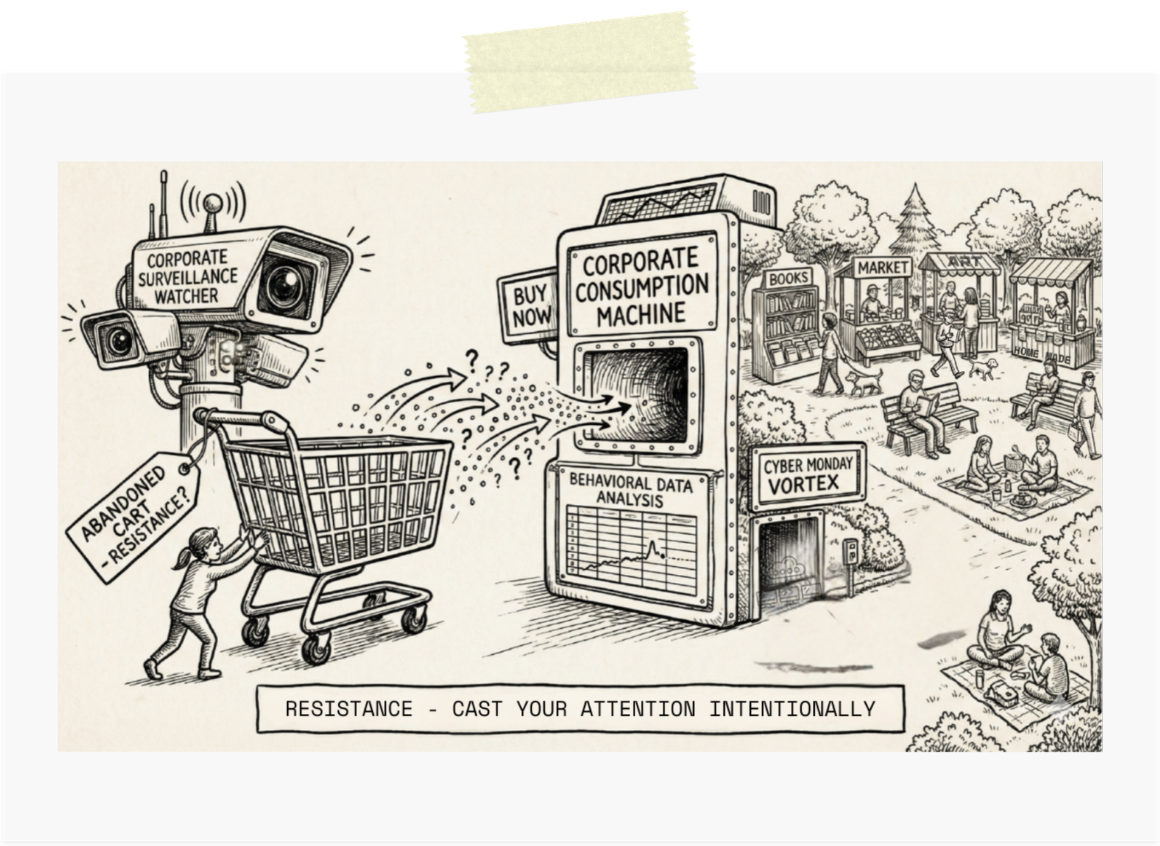
What an Abandoned Cart Really Is
Leaving items in an online cart doesn’t take money from any corporate pocket. Nothing is manufactured on your behalf. No worker is asked to re-shelve anything. No stockroom shifts. There is no wound.
Your hesitation becomes something else entirely: a data point.
Retailers expect high abandonment rates. They build their systems around it. They study it. They use it. Teams spend their days analyzing where you paused, what you clicked, and what might convert you next time.
An abandoned cart doesn’t make the machine flinch; instead, it fuels it.
What Happens Behind the Screens
Here’s the actual chain reaction when you walk away:
Your hesitation is logged as behavioral insight, not sabotage.
Automated marketing begins: reminders, follow-up emails, the ads that trail you online.
Nothing is held or reserved; inventory carries on untouched.
A few dashboards dip slightly, but the system keeps humming.
It’s ordinary, predictable, expected.
So if the abandoned cart isn’t a blow to corporate greed, why does the trend resonate so strongly right now?
The Symbolism Matters
People are feeling squeezed – by inflation, by relentless sales cycles, by a culture that treats buying as participation. Cyber Monday has become less about deals and more about a yearly behavioral ritual built to trigger speed over intention.
The impulse to push back, even symbolically, tells a story.
It says: I notice the tactics.
I feel the pressure.
And I’m not sure I want to play anymore.
That instinct is important. But the meaningful resistance doesn’t live in the cart. It lives in the pause.
Where Real Resistance Shows Up
If people want to shift the landscape, there are pressure points that actually matter:
Choosing to buy less – as a practice, not a holiday exception.
Supporting small and local businesses where your money has a visible impact.
Buying used, borrowing, repairing, and trading.
Curating experiences instead of accumulation.
Treating attention as a resource, not something to hand over every time a company rings the bell.
These choices move markets. They reshape incentives. They influence how future systems are built.
A Strange Mirror for the Season
Cyber Monday reveals a lot about modern systems: one massive, coordinated effort to shape behavior. But it also reveals the counterforce of millions of small moments where people hesitate, question, or step back.
The abandoned cart trend won’t topple corporate greed. It was never going to. But it points toward something more compelling: the quiet rise of awareness.
People are beginning to see the machinery.
They’re noticing the pressure.
And they’re reclaiming the right to choose their own pace.
Corporations don’t fear abandoned carts. They fear consumers who stop playing by their script.
That’s where the shift begins.
Read more in my Medium article titled Leaving Items Abandoned in Your Cart Won’t Hurt Corporations — But Something Else Might
Cyndi Coon is a time traveler and rule-bender, nerding out for good using data, science and curious questions as an Applied Futurist, author, creative, ecosystem builder, facilitator, producer, researcher, storyteller and publisher for: governments, the military, higher education, private partnerships, enterprise, and industry. Cyndi is the Founder and Principal Futurist at Applied Futures Lab, Founder of Laboratory5, and Co-founder of Arizona State University’s Threatcasting Lab and Press, and is the co-founder at Threatcasting.ai. Cyndi is the co-author of Threatcasting (2021), Futurecasting (2026) and the author of numerous reports, articles and book chapters. Founder and Publisher at Turkey Hill Press.She is an Affiliate at the Center for Emergency Management & Homeland Security. Chief Media Officer for Content Evolution. She leads the i4j (global innovation for jobs workforce) and Coolabilities communities, promoting inclusive and forward-thinking solutions. She is a Web 3 advisor and a Future AI Mindset expert. Connect with Cyndi at Applied Futures Lab Linktree or LinkedIn.




 Lab5 BLOG