A portable curiosity lab built from old tote bags, imagination, and the belief that humans still think with their hands.
This summer I’m heading out on a lot of adventures. Road trips. Research trips. Workshops and Protoyping Parties. The kind where you stop because a hand-painted sign catches your eye. The kind where you pull over because there’s an abandoned building, a roadside museum, a community gathering, or a strange object that sparks a question.
As a futurist, I’ve spent years helping people imagine possible futures. I’ve worked with AI, emerging technologies, complex systems, and organizations trying to make sense of change. And yet, the more time I spend exploring the future, the more I find myself reaching for analog tools. A notebook, a sketchbook, sticky notes, pens, paper maps, and a pocket full of questions.
So this summer I’m building an Analog Futurist Travel Kit. Not buying one. Building one.
Next week I’ll be working at the Open Community Sewing Room at the Talpa Community Center & Library in Taos, New Mexico, a completely free community space where you can show up and folks are there to support your sewing efforts. I’ll transform a collection of free giveaway canvas tote bags into something completely different: a portable curiosity lab that opens flat on a table and folds into a travel bag.
Part organizer. Part field kit. Part creative studio. Part thinking machine.
The design started with a simple question: If I could carry everything I need to observe, collect, create, reflect, and imagine in one place, what would it contain?
The answer turned out to be a series of zones.
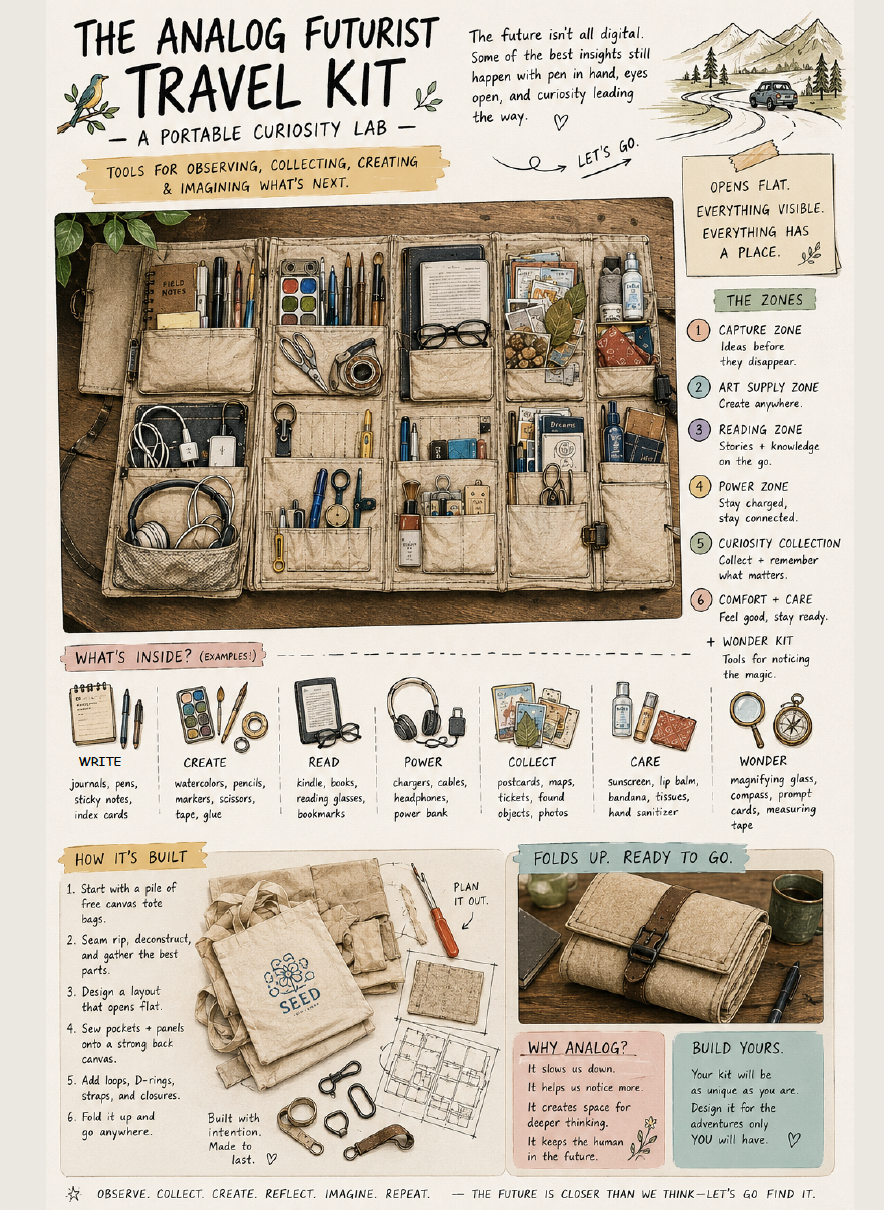
Zone 1: The Capture Zone
This is where ideas go before they disappear.
The Capture Zone holds journals, field notebooks, sticky notes, index cards, favorite pens, pencils, and whatever happens to be helping me think at the moment. Every futurist eventually learns the same lesson: ideas are migratory creatures. If you don’t catch them when they land, they leave.
This zone is designed to eliminate friction between noticing and recording. No searching. No digging. No wondering where the notebook is. Just open, write, capture.
The Capture Zone is the front porch of the kit. It’s where observations arrive first. A strange sign along a back road. A sentence overheard in a coffee shop. A question that appears without warning. A future signal that doesn’t make sense yet but feels important enough to save.
Most ideas don’t announce themselves. They show up quietly and disappear just as quickly. This zone exists to make sure they have somewhere to land.
When curiosity knocks, the door is already open.
Zone 2: The Art Supply Zone
People often separate thinking from making. I don’t.
Drawing is thinking. Sketching is thinking. Building rough prototypes is thinking.
The Art Supply Zone contains watercolor supplies, colored pencils, markers, scissors, tape, brushes, and small tools. Some observations are easier to draw than describe. Some ideas don’t fully exist until your hands interact with them. This zone reminds me that imagination isn’t just intellectual. It’s physical.
Sometimes a sketch reveals a pattern that words miss. Sometimes a splash of color unlocks an idea that has been sitting just beyond reach. Sometimes the simple act of moving a pencil across paper helps untangle a problem that seemed impossible a few minutes earlier.
This is the zone for experimentation. For doodles in the margins. For diagrams, maps, collages, and visual notes. For making ideas visible enough to examine, challenge, and improve.
Not every insight arrives as a sentence.
Some arrive as a shape.
A color.
A sketch.
A mark on a page.
This zone creates space for those ideas too.
Zone 3: The Reading Zone
Books are time machines.
The Reading Zone contains a Kindle, whatever book I’m currently carrying, reading glasses, bookmarks, and tabs. Travel creates unusual moments of waiting. Coffee shops. Libraries. Park benches. Trailheads.
A good reading zone turns waiting into exploration.
I’ve come to appreciate those in-between moments. The hour before a meeting. The extra time before a museum opens. A quiet morning in an unfamiliar town. A shaded bench after a long walk. What might feel like downtime becomes an opportunity to wander through someone else’s ideas, experiences, and questions.
Reading while traveling creates unexpected connections. A sentence from a book suddenly echoes something you saw earlier that day. An idea from a chapter reframes a conversation with a stranger. A passage that seemed abstract at home becomes vivid when viewed through the lens of a new place.
This zone is more than a place to store books. It’s a place to store perspective.
When you’re moving through the world, it’s easy to focus on what’s next. Reading invites you to pause, reflect, and linger a little longer with an idea. Sometimes the most valuable discoveries of a trip aren’t found on a map. They’re found in the pages of a book you happened to open at exactly the right moment.
A good reading zone doesn’t just help pass the time.
It helps deepen it.
Zone 4: The Power Zone
Yes, this is an analog kit. No, I am not pretending technology doesn’t exist.
The Power Zone contains chargers, cables, battery packs, headphones, and the necessary support systems that keep modern tools functioning. The goal isn’t to reject technology. The goal is to put it in its place. Technology becomes one tool among many instead of the center of the experience.
For years we’ve been told that more technology is the answer to almost everything. More apps. More notifications. More connectivity. More devices. But I’ve found that the real challenge isn’t access to technology. It’s deciding when technology is useful and when it becomes a distraction.
The Power Zone is intentionally practical. It exists so I don’t have to think about chargers, tangled cables, dead batteries, or missing headphones when I need them. Everything has a home. Everything is easy to find. Everything is ready when needed.
Ironically, a well-organized technology zone creates more space for analog experiences. When my devices are charged and contained, they fade into the background. My attention can return to the road, the landscape, the conversation, the sketchbook, the book, or the question I’m trying to answer.
Technology is a remarkable tool. But it’s still a tool.
A camera captures the moment, a notebook helps me understand it, and headphones create focus. Curiosity creates meaning. This zone supports the journey without becoming the destination.
Zone 5: The Curiosity Collection
This may be my favorite section.
Postcards. Maps. Tickets. Found objects. Business cards. Leaves. Sketches. Photographs. Mysterious things with unknown stories.
I’ve spent years studying signals of change. The future rarely announces itself with a press release. It often arrives disguised as a small thing someone else overlooked. This zone exists to collect those clues.
A handwritten note on a community bulletin board. A grocery receipt left in a cart. An unusual product on a store shelf. A local newspaper headline. A flyer. A menu. A conversation scribbled into a notebook. A postcard purchased because it captured the spirit of a place better than any photograph could.
Most people travel through places. I like to collect evidence from them.
Not evidence in the formal sense. Evidence of how people are living, adapting, creating, struggling, celebrating, and imagining. Evidence of emerging behaviors, changing values, unexpected solutions, and small signals that hint at larger shifts.
Some of the items in this pocket may never become anything more than interesting souvenirs. Others may become the first clue in a larger pattern that only reveals itself months or years later.
That’s the thing about curiosity. You don’t always know what matters when you find it. You simply know it’s worth saving. This zone gives those discoveries a place to live until their stories become clearer.
It’s part archive. Part field collection. Part treasure chest.
A reminder that some of the most valuable insights begin as small, ordinary things tucked into a pocket and carried home.
Zone 6: Comfort and Care
The older I get, the more I appreciate designing for reality.
Reading glasses. Lip balm. Bandanas. Tissues. Sunscreen. Tiny comforts.
Future thinking is easier when you’re not distracted by preventable discomfort. This is less glamorous than the other zones, but arguably more important.
The Wonder Kit
Every good futurist needs a little wonder.
So I’m adding a collection of playful tools: a magnifying glass, a small compass, future signal cards, prompt cards, blank postcards, perhaps a tiny measuring tape, and possibly a few completely unnecessary objects that simply make me smile.
Because curiosity deserves infrastructure too.
Why This Matters
The deeper I work with AI, the more valuable analog tools become. Not because technology is bad. Not because nostalgia is superior. But because attention is becoming increasingly precious.
The notebook asks less from me than a screen. Paper doesn’t send notifications. A sketchbook doesn’t interrupt itself. An index card doesn’t compete for my attention.
Analog tools create space. And space is often where new ideas appear.
If This Idea Resonates With You
Don’t start with tote bags. Don’t start with pockets. Don’t start with sewing.
Start with a list.
Ask yourself what you actually reach for when you’re curious. What tools help you notice more? What helps you think? What helps you create? What helps you remember? What helps you collect stories? What helps you stay present?
Your kit might look completely different from mine. A birder’s bag. A writer’s bag. A scientist’s bag. A gardener’s bag. A teacher’s bag. A grandparent’s bag. A road-tripper’s bag. A dreamer’s bag.
The point isn’t the bag. The point is intentionally designing a portable environment that supports the kind of person you’re becoming.
Mine happens to be an Analog Futurist Travel Kit. A collection of pockets dedicated to curiosity. Built from old tote bags. Powered by imagination. Ready for whatever adventures this summer decides to offer.
Cyndi Coon is a time traveler and rule-bender, nerding out for good using data, science and curious questions as an Applied Futurist, author, creative, ecosystem builder, facilitator, producer, researcher, storyteller and publisher for: governments, the military, higher education, private partnerships, enterprise, and industry. Cyndi is the Founder and Principal Futurist at Applied Futures Lab, Founder of Laboratory5, and Co-founder of Arizona State University’s Threatcasting Lab and is the co-founder at Threatcasting.ai. Cyndi is the author of Future AI Mindset, co-author of Threatcasting (2021), Futurecasting (2026) and the author of numerous reports, articles and book chapters. Founder and Publisher at Turkey Hill Press.
She is an Affiliate at the Center for Emergency Management & Homeland Security. Chief Media Officer for Content Evolution. She leads the i4j (global innovation for jobs workforce) and Coolabilities communities, promoting inclusive and forward-thinking solutions. She is a Web 3 advisor. Connect with Cyndi Linktree

 Lab5 BLOG