I recently spent the day at Northern New Mexico College, surrounded by middle school girls, cardboard, tape, and a whole lot of imagination.
I was invited by the New Mexico Network for Women in Science and Engineering to lead workshops as part of their “Exploring the Possibilities” STEM event. They organize these experiences across the state, and you can feel the impact immediately. The room was full of curiosity before we even started.
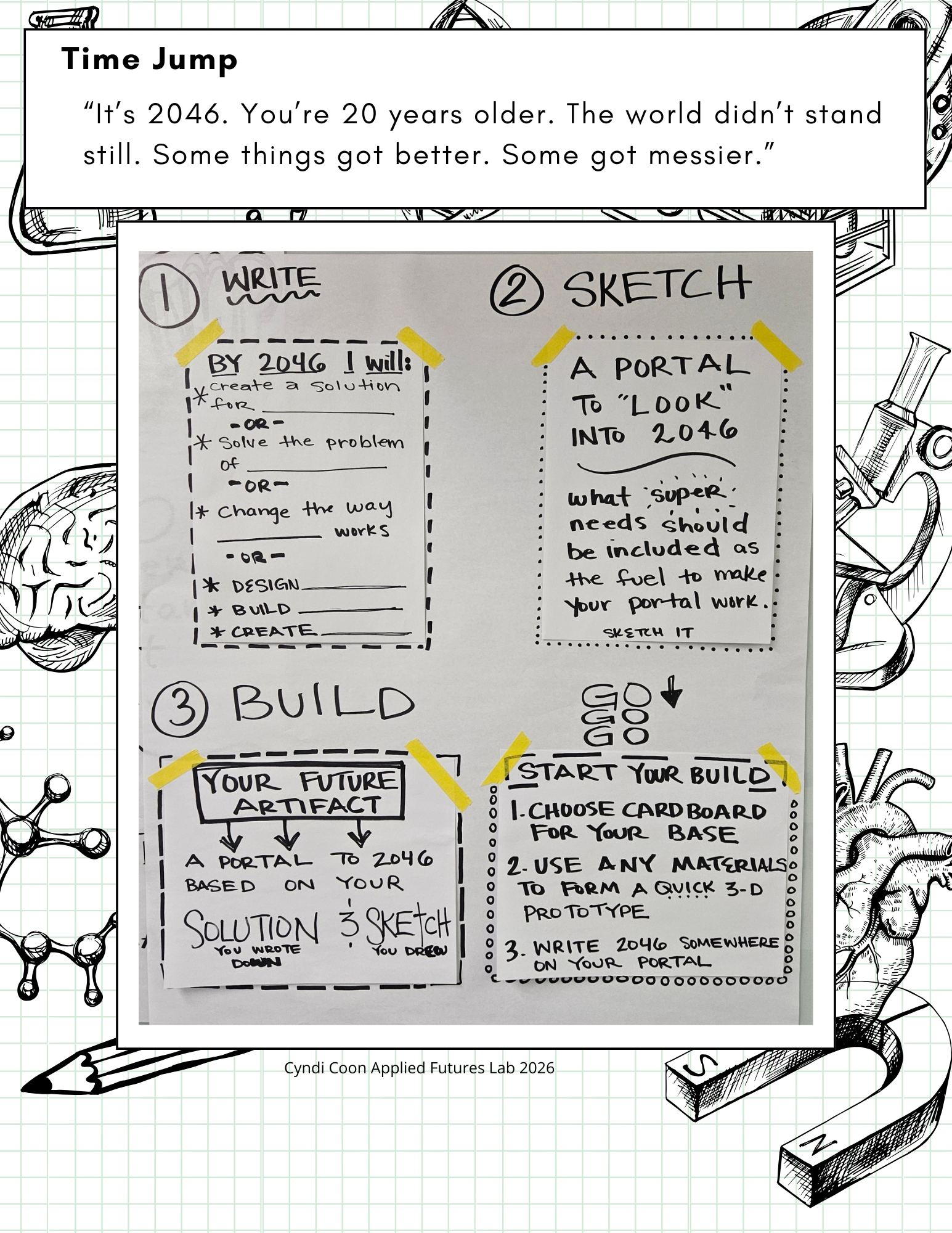
We began with a time jump. It’s 2046. You’re 20 years older. The world didn’t stand still. Some things got better, some got messier.
I asked them to write quickly, no overthinking, about one thing they would fix, solve, or change before then. That shift, from now to later, changed the energy in the room. Suddenly, they weren’t just students. They were decision-makers.
From there, we moved into sketches and then into building. Cardboard bases, tape and glue everywhere, beads, and scraps. It got messy fast, in the best possible way. They built what we called future artifact portals, physical objects from 2046 that solve a problem they care about.
Not ideas floating around, but something you could hold, point to, and explain.
As they worked, the thinking started to surface. Who uses this? When? What does it change? What might it break? Without calling it anything formal, they were working through systems, cause and effect, and the reality that every object carries choices inside it.
What I love about this kind of work is how quickly it becomes real for them. The future stops feeling distant. It becomes something you can shape. You can see it happen in their hands, in the way they test, adjust, and explain their builds to each other.
It was collaborative and full of energy. The kind of learning that doesn’t sit still. I got to walk them through what being a futurist looks like in practice: not guessing, but making. Prototypes, sketches, artifacts. Evidence of ideas. It was so fun. There’s something powerful about stepping away from screens and building in the physical world. You can watch thinking happen in real time. You can see confidence grow as something takes shape.
The discussion is loud, fast, and often technical. New tools appear every week. Headlines promise transformation, disruption, automation, acceleration.
But the deeper work is quieter.
It lives in how we think.
Over the past few years, I’ve been studying how people interact with intelligent systems. The same technology lands in different hands and produces completely different outcomes. Some people feel overwhelmed. Others find creative momentum. Some freeze. Others experiment.
If you’ve been paying attention to the conversation around AI, you’ve probably noticed something strange.
Artificial intelligence is often described as a technological shift. In reality, it is also reshaping how we think, decide, collaborate, and imagine consequences across time.
When systems can generate ideas, synthesize information, and participate in creative processes, our relationship with knowledge changes. Our relationship with uncertainty changes. Even our relationship with time shifts.
The challenge is not simply learning new tools.
The challenge is learning how to think clearly inside systems that keep evolving.
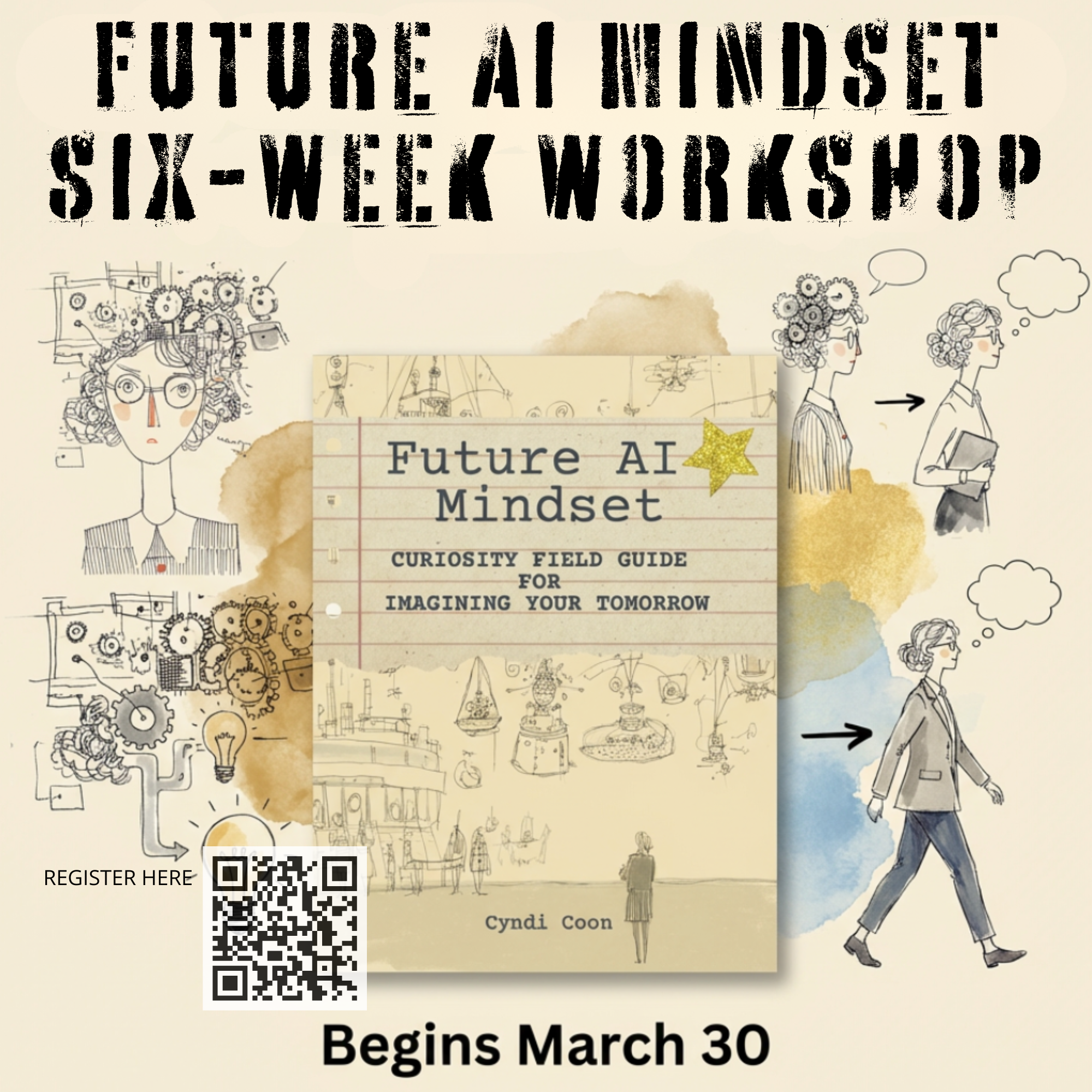
The Future AI Mindset workshop was designed to address that challenge. It translates the ideas from the book into a structured thinking practice.
This approach is grounded in my work as an applied futurist and in the foresight methods I helped co-create over the years: Threatcasting, Futurecasting, andAppliedExperiential Futures. These methods were developed in environments where imagination must be disciplined and decisions carry real consequences.
Enterprise strategy. Government planning. Defense scenarios. Higher education. Innovation labs.
The goal in those environments is not prediction. It is orientation. Helping people think clearly in the presence of uncertainty.
The workshop brings that same discipline into our relationship with AI.
What We Explore Together
The six-week program is designed as a live thinking lab.
Each week we explore a different dimension of the Future AI Mindset framework, combining discussion, reflection, and practical exercises drawn directly from the book.
Participants will examine questions such as:
How does AI reshape cognition and creativity? What does collaboration look like when some collaborators are intelligent systems? How do we maintain judgment when machines produce convincing outputs? How do we think across time when technological change accelerates?
Instead of rushing toward answers, we practice structured curiosity.
We explore scenarios. We examine assumptions. We learn to hold multiple possible futures at once without collapsing into certainty.
These are skills futures thinkers have practiced for decades, and they are becoming increasingly valuable in AI-integrated environments.
What You Will Build
By the end of the six weeks, participants leave with more than notes or ideas. They will have built a set of practical tools they can continue using.
These include:
A personal Future AI Mindset statement that clarifies how you want to engage with intelligent systems.
An Applied Futures Map that connects present decisions with longer-term possibilities.
A backcasting pathway, working from a future you want toward actions you can take today.
A decision anchor that helps guide choices in moments of uncertainty.
And perhaps most important, a personal thinking practice that can travel with you into your work, teams, and projects.
These artifacts are designed to remain useful long after the workshop ends.
Who This Is For
This workshop is designed for people who sense that AI is not just changing technology. It is changing the terrain we think and act within.
Leaders making strategic decisions without complete information.
Educators preparing students for futures we cannot fully describe yet.
Researchers, designers, and builders working inside emerging systems.
Curious professionals who want to remain intentional rather than reactive.
If you have ever felt the acceleration and thought, I need to be thoughtful about how I navigate this moment, you are exactly the kind of person this workshop was designed for.
The Structure
The program runs for six weeks and meets live once a week.
Start date: March 30, 2026 Session length: One hour each week Format: Live virtual sessions with recordings available
And if someone comes to mind who might enjoy spending an hour a week thinking about the future together, feel free to share it with them.
The future is not something we simply wait for.
It is something we learn to think into.
Cyndi Coon is a time traveler and rule-bender, nerding out for good using data, science and curious questions as an Applied Futurist, author, creative, ecosystem builder, facilitator, producer, researcher, storyteller and publisher for: governments, the military, higher education, private partnerships, enterprise, and industry. Cyndi is the Founder and Principal Futurist at Applied Futures Lab, Founder of Laboratory5, and Co-founder of Arizona State University’s Threatcasting Lab and is the co-founder atThreatcasting.ai. Cyndi is the author of Future AI Mindset, co-author of Threatcasting (2021), Futurecasting (2026) and the author of numerous reports, articles and book chapters. Founder and Publisher at Turkey Hill Press.
We are in the midst of one of the most transformative technological revolutions in history. Artificial Intelligence (AI) is not coming—it has arrived. It is reshaping industries, redefining creativity, and altering the way we work and connect. But here’s the truth: AI is not our competition—it is our amplifier.
The real question isn’t how to outrun AI; it’s how to harness uniquely human strengths to thrive in an AI-enhanced world. The answer lies in future-ready skills—our true superpower in this new landscape.
Many fear that AI will replace jobs, eliminate creativity, and render human contributions obsolete. While automation will shift industries, AI is not replacing human ingenuity—it is augmenting it.
What sets us apart? Empathy, creativity, adaptability, and collaboration—capabilities that no AI can fully replicate. These are the essential future-ready skills that will define success in the AI era:
Empathy & Emotional Intelligence AI can analyze data, but it cannot truly understand human emotions, cultural nuances, or the depth of human experiences. The ability to connect, empathize, and create meaningful relationships will always be in demand.
Creativity & Imagination AI is powerful at remixing ideas, but it struggles with true innovation and intuitive leaps. Humans dream, invent, and disrupt in ways that AI cannot. The future belongs to those who use AI as a creative tool, not a replacement.
Adaptability & Problem-Solving AI follows patterns; humans break them. When unexpected challenges arise, we improvise, pivot, and reimagine solutions—qualities that no algorithm can predict.
Futures Networks & Collaboration AI does not build meaningful connections—people do. The ability to cultivate diverse networks, share insights, and co-create will be the foundation of thriving in an AI-powered world.
Why Future-Focused Networks Matter More Than Ever
The AI revolution is not about going it alone—it’s about community-driven innovation. Collaboration is the key to progress. The most AI-resilient individuals are those who actively build, engage, and learn from future-focused networks.
The Power of Collective Intelligence
Shared Knowledge: AI tools evolve rapidly. Surrounding yourself with curious and innovative thinkers keeps you ahead of the curve.
Support & Inspiration: The AI space is full of pioneers. Being part of an ecosystem of creators and learners fuels motivation and breakthrough ideas.
Co-Creation Over Competition: The AI revolution isn’t about one person winning—it’s about collective growth. The more we share, the more we all advance.
How to Co-Create and Thrive in the AI Era
The future belongs to those who build intentional systems for innovation, collaboration, and adaptability. Whether you’re an artist, entrepreneur, educator, or leader, designing structures that leverage AI effectively will be critical.
Practical Ways to Stay Future-Ready:
Join AI Learning Ecosystems: Engage in meetups, mastermind groups, and online communities where AI knowledge is shared openly.
Design for Co-Creation: AI is most powerful when used collaboratively. Develop workflows that encourage experimentation and cross-disciplinary innovation.
Prioritize Ethical AI Use: AI is only as good as its human intent. As AI adoption grows, ensuring ethical and human-centered design is critical.
Stay in a Playful Mindset: The best way to understand AI is to play with it. Experiment with tools like MidJourney, ChatGPT, Suno, and others. Stay curious and adaptive.
Mastering Attention in the AI Era
As AI amplifies both opportunities and distractions, mastering your attention is a future-ready skill in itself.
Enter Attentioncasting—a strategic approach to directing focus towards meaningful work, creative breakthroughs, and human connection. In an era of endless digital noise, the ability to filter, prioritize, and engage with clarity will be a game-changer.
The future isn’t just about keeping up—it’s about leading with intention and purpose.
Embracing the Future—Together
AI is not the enemy—it’s a tool. And the most powerful tools are wielded by those who understand how to integrate them into human-first innovation.
By cultivating future-ready skills, embracing collaborative ecosystems, and designing intentional systems for co-creation, we can shape a future that is not only AI-enhanced but profoundly human-driven.
The real superpower in the age of AI is not technical expertise—it’s the ability to remain deeply human, lead with curiosity, and design the future we all want to live in.
Cyndi Coon is a time traveler and rule-bender, nerding out for good using data, science and curious questions as an Applied Futurist, author, creative, ecosystem builder, facilitator, producer, researcher, storyteller and publisher for private partnerships, enterprise, governments, the military, higher education, and industry. She is an Affiliate at the Center for Emergency Management & Homeland Security. Co-Chair of the Human Wisdom Committee IEEE Planet Positive. Chief Media Officer for Content Evolution. She leads the i4j (global innovation for jobs workforce) and Coolabilities communities, promoting inclusive and forward-thinking solutions. She is a Web 3 andGenerative AI Mindset advisor.Cyndi is the Founder and Principal Futurist at Applied Futures Lab, Founder of Laboratory5, and Founder and Publisher at Turkey Hill Press. Co-founder of Arizona State University’s Threatcasting Lab and Press, where she collaborates with diverse teams to anticipate future threats and opportunities. Cyndi is the co-author of Threatcasting (2021) and the author of Thrive! Creative’s Guidebook to Professional Tenacity (2019), numerous reports, articles and book chapters. Her use of imagination, combined with her playful approach to research, drives her passion for human-centered, self-powered innovation. Connect with Cyndi at Linktree or LinkedIn.
 Lab5 BLOG