Introducing AttentionCasting: A New Framework from Applied Futures Lab
At Applied Futures Lab, we’re always exploring ways to help you navigate complexity and prepare for what’s next. Our latest offering, AttentionCasting, is a framework designed to help leaders like you focus on what truly matters amid the noise and uncertainty of today’s world.
Why AttentionCasting?
Attention is a finite asset, yet it often goes unmanaged in the face of competing priorities. AttentionCasting emerged from our work with foresight methodologies like Threatcasting and Futurecasting, but it takes a distinct approach. Instead of focusing solely on risks or imagined futures, AttentionCasting helps you direct your focus where it counts—toward opportunities, challenges, and strategies that align with your goals.
The Three Phases of AttentionCasting
Here’s how it works:
Scanning and Filtering: Identify the most critical trends, signals, and data while cutting through the noise.
Focus Setting: Define specific objectives and outcomes, ensuring attention is purposefully aimed.
Sustained Engagement: Maintain focus over time with tools and practices that keep your priorities on track.
Check out this YouTube Explainer on AttentionCasting:
The Value for You
AttentionCasting offers leaders a pathway to clarity and action. It helps you:
Make informed, impactful decisions.
Align actions with long-term goals.
Empower your teams with clear priorities.
Build organizational resilience to adapt and thrive.
What’s Next?
I’m excited to share this new framework with you. Whether you’re navigating digital transformation, tackling social challenges, or simply striving to manage competing priorities, AttentionCasting is here to guide your focus and amplify your impact. Get in touch!
Check out Cyndi’s Linktree for more information on her activities.
First, what is a GPT? Generative Pre-trained Transformer, which is a type of artificial intelligence (AI). It’s a family of large language models (LLMs). The cool thing about GPTs is you can very easily build your own custom bots to do things for you.
There’s been a big update:
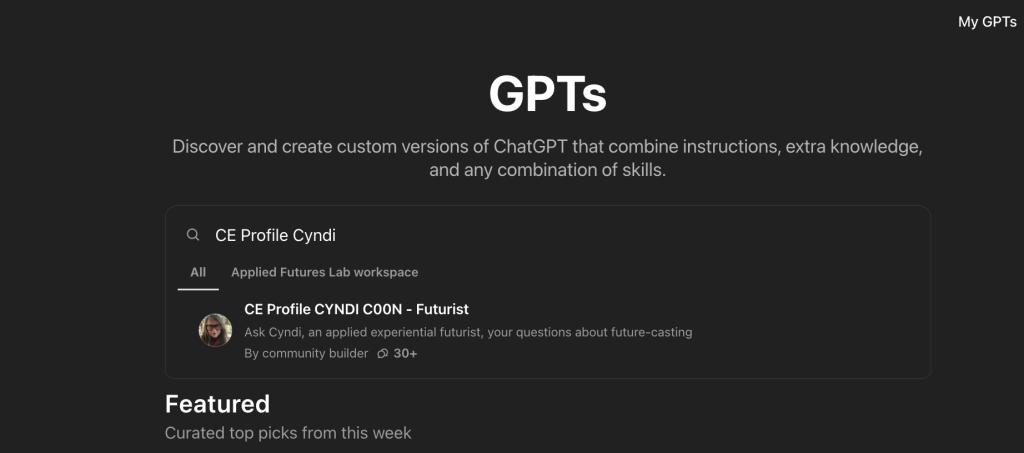
Any ChatGPT user can now use all custom GPTs. It used to be only subscribers could use each other’s GPTs. Now with Free 4.o anyone can use Chat GPT and use the Open AI GPT Directory to find GPTs.
Visual of the GPT Directory (above)
Only paid subscribers can build them at this time, but everyone can access them now. I have many GPTs; some are public, and some are not. I have posted some of my public GPTs on my Linktr.ee if you fancy taking any of them for a spin. If you are a subscriber and haven’t built a custom GPT yet – get on it!
Technological advancements are continuously reshaping our world, and one of the most intriguing developments in the future of creativity is the role of Artificial Intelligence (AI). As an Applied Futurist, I’ve closely observed and engaged with this evolution, and I’m excited to share my perspective on how AI is revolutionizing the creative landscape.
AI’s role in the arts and creativity is transformative, serving as a collaborator that enhances my own human potential rather than replacing it. I am in no way afraid of this technology. I can see and feel the fear from other creatives who go immediately to “This is going to replace us.” It isn’t. Whenever new technology creeps into the human experience, we go straight to fear and survival. When photography first came out as a medium the Fine Artists with a capital FA, yelled and wouldn’t allow photographs in shows, they were concerned what would happen with art if one artist could make copies of their work and sell it many times over. Today, we don’t talk about photographs in that way because we realize that creatives will still create. Movies were exciting but caused a big stir in the theatre community as they thought no one would ever go to the theatre again if you could just record the actors and play the film at any time to any audience. Mathaleticians were up in arms when the calculator came out. Convinced that people would no longer do math because the calculator would cheat for them. Does all of this sound familiar to today’s rhetoric about AI?
Here’s the thing: AI does have dangerous sides, dark sides, and deep web possibilities. There is plenty to fear about the future of AI, but I would ask – What can you control? Do you have a degree in cyber security or work in the intelligence field? If your answer is no, then the very best thing you can do, as a creative or not, is to jump in. Get informed, educated and familiar with these tools. We can jump up and down all we want, but they are not going away. Learning them is our individual path for the future.
AI is not taking over the creative process, but instead is augmenting and amplifying human ingenuity. From the perspective of an artist, imagine having a partner who never tires, continually bringing new ideas to the table, and expanding the limits of your imagination. AI is redefining the traditional boundaries of creativity. It’s not just about creating art or writing stories; it’s about venturing into unexplored territories of creativity. With its ability to analyze vast amounts of data, spot trends, and synthesize information rapidly, AI enables artists to move swiftly from concept to prototype, tailoring creative outputs to specific tastes and preferences.
One of the most exciting aspects of AI in creativity is its democratizing effect. AI tools are becoming more accessible, allowing people from all walks of life to engage in creative activities. Whether you are a seasoned artist or a novice, AI levels the playing field, providing tools that assist in the creative process and making art more inclusive and diverse.
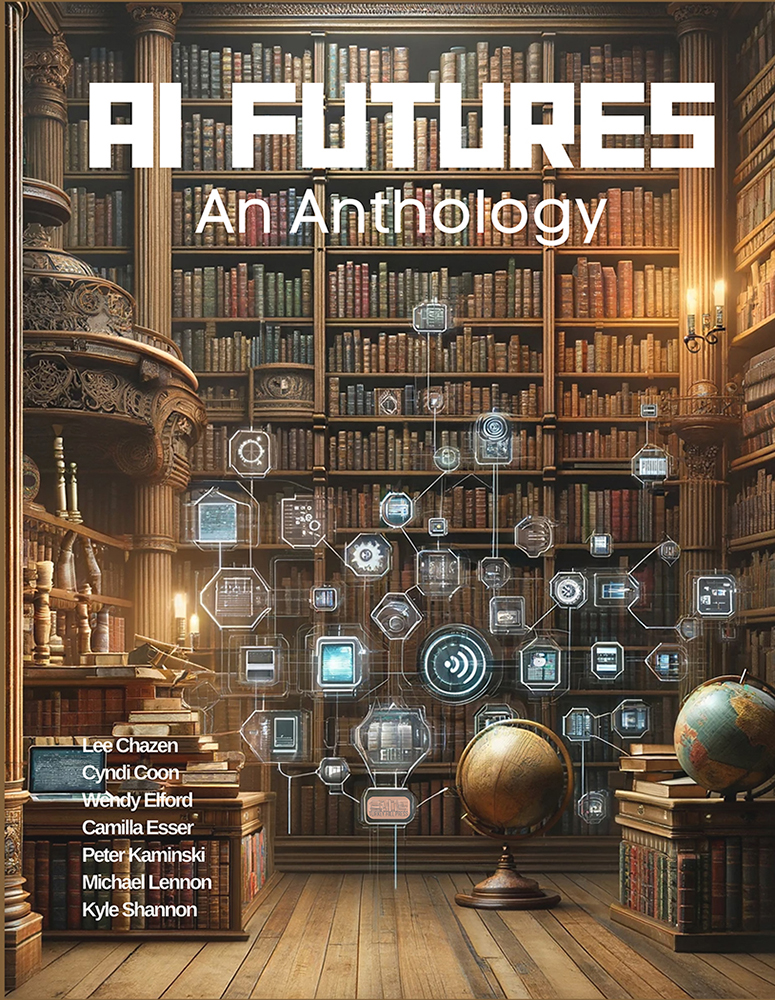
TI have been hanging out in AI play spaces where people from all different disciplines are gathering to connect and play, to experiment and to ask curious questions together. From one of these groups I came to meet seven amazing humans who are all on this journey and we decided to map it – together. We started by each writing down our experiences to date as we have engaged in AI. We create an anthology together as round one. It is called AI Futures An Anthology. Our next steps will be to video nd audio record our chapters and use those inside AI to create more things. It is an exciting play space to explore.n
As an Applied Experiential Futurist, I invite you to consider how AI can enhance your creative or professional work. Whether it’s through an AI-assisted design project, a data-driven marketing campaign, or an AI-curated educational curriculum, the opportunities are endless.
How will you embrace AI in your creative journey? Share your thoughts, and let’s continue to explore this exciting frontier together.
For more insights into the future of AI and creativity, visit Applied Futures Lab. To discuss these concepts further or get personalized guidance, connect with Cyndi Coon, on LinkedIn.

 Lab5 BLOG