How the Future is Being Built: The Interplay of Human Potential and Technology

Today the relationship between technology and human potential is no longer a distant concept—it’s unfolding in real time. From AI-powered creativity to biotech breakthroughs, the landscape of what we can achieve is expanding at an unprecedented pace. But with all this change comes a critical question:

How do we ensure that technological progress enhances human potential rather than diminishes it?

For years, the conversation around innovation has been focused on what’s possible. Can we build AI that thinks like us? Can we engineer genetic modifications to extend life? Can we integrate technology into our bodies for enhanced cognition? These questions, once the domain of speculative fiction, are now becoming a reality. However, the more pressing question is no longer what we can build, but how we ensure these advancements serve humanity in meaningful ways.

The shift isn’t just about technological capability—it’s about human adaptability. The workforce is evolving, education is transforming, and the way we connect with one another is fundamentally changing. AI is not just an assistant; it’s becoming a creative collaborator. Brain-computer interfaces are no longer a wild idea; they’re actively being tested. In this environment, the greatest skill anyone can cultivate isn’t just technical proficiency—it’s futures thinking.

This is where the interplay of technology and human potential becomes more than a theoretical discussion. It’s about how we navigate this transformation, ensuring that innovation aligns with human values and needs.

In my latest article on Medium, “The Interplay Between Technology and Human Potential: Unleashing a Thriving Future,” I explore:

🔹 How AI is reshaping creativity and democratizing access to artistic expression
🔹 The evolving role of human intelligence in a world increasingly augmented by machines
🔹 The future of work, learning, and the redefinition of human value in an automated economy
🔹 The ethical and social implications of human enhancement technologies
🔹 How we can design a future that prioritizes humanity, inclusion, and well-being

As technology accelerates, we are at a crossroads. Do we passively adapt to the changes around us, or do we take an active role in shaping the future? The answer lies in how we integrate these advancements into our lives, communities, businesses, and societies.

Ready to explore what’s next? Read the full article here and let’s chart a path toward a future where human potential is not just preserved—but amplified.

+++

Cyndi Coon is a time traveler and rule-bender, nerding out for good using data, science and curious questions as an Applied Futurist, author, creative, ecosystem builder, facilitator, producer, researcher, storyteller and publisher for private partnerships, enterprise, governments, the military, higher education, and industry. She is an Affiliate at the Center for Emergency Management & Homeland Security. Co-Chair of the Human Wisdom Committee IEEE Planet Positive. Chief Media Officer for Content Evolution. She leads the i4j (global innovation for jobs workforce) and Coolabilities communities, promoting inclusive and forward-thinking solutions. She is a Web 3 and Generative AI Mindset advisor.Cyndi is the Founder and Principal Futurist at Applied Futures Lab, Founder of Laboratory5, and Founder and Publisher at Turkey Hill Press. Co-founder of Arizona State University’s Threatcasting Lab and Press, where she collaborates with diverse teams to anticipate future threats and opportunities. Cyndi is the co-author of Threatcasting (2021) and the author of Thrive! Creative’s Guidebook to Professional Tenacity (2019), numerous reports, articles and book chapters. Her use of imagination, combined with her playful approach to research, drives her passion for human-centered, self-powered innovation. Connect with Cyndi at Linktree or LinkedIn.
Artists and Algorithms

Technological advancements are continuously reshaping our world, and one of the most intriguing developments in the future of creativity is the role of Artificial Intelligence (AI). As an Applied Futurist, I’ve closely observed and engaged with this evolution, and I’m excited to share my perspective on how AI is revolutionizing the creative landscape.

AI’s role in the arts and creativity is transformative, serving as a collaborator that enhances my own human potential rather than replacing it. I am in no way afraid of this technology. I can see and feel the fear from other creatives who go immediately to “This is going to replace us.” It isn’t. Whenever new technology creeps into the human experience, we go straight to fear and survival. When photography first came out as a medium the Fine Artists with a capital FA, yelled and wouldn’t allow photographs in shows, they were concerned what would happen with art if one artist could make copies of their work and sell it many times over. Today, we don’t talk about photographs in that way because we realize that creatives will still create. Movies were exciting but caused a big stir in the theatre community as they thought no one would ever go to the theatre again if you could just record the actors and play the film at any time to any audience. Mathaleticians were up in arms when the calculator came out. Convinced that people would no longer do math because the calculator would cheat for them. Does all of this sound familiar to today’s rhetoric about AI?

Here’s the thing: AI does have dangerous sides, dark sides, and deep web possibilities. There is plenty to fear about the future of AI, but I would ask – What can you control? Do you have a degree in cyber security or work in the intelligence field? If your answer is no, then the very best thing you can do, as a creative or not, is to jump in. Get informed, educated and familiar with these tools. We can jump up and down all we want, but they are not going away. Learning them is our individual path for the future.

AI is not taking over the creative process, but instead is augmenting and amplifying human ingenuity. From the perspective of an artist, imagine having a partner who never tires, continually bringing new ideas to the table, and expanding the limits of your imagination. AI is redefining the traditional boundaries of creativity. It’s not just about creating art or writing stories; it’s about venturing into unexplored territories of creativity. With its ability to analyze vast amounts of data, spot trends, and synthesize information rapidly, AI enables artists to move swiftly from concept to prototype, tailoring creative outputs to specific tastes and preferences.

One of the most exciting aspects of AI in creativity is its democratizing effect. AI tools are becoming more accessible, allowing people from all walks of life to engage in creative activities. Whether you are a seasoned artist or a novice, AI levels the playing field, providing tools that assist in the creative process and making art more inclusive and diverse.

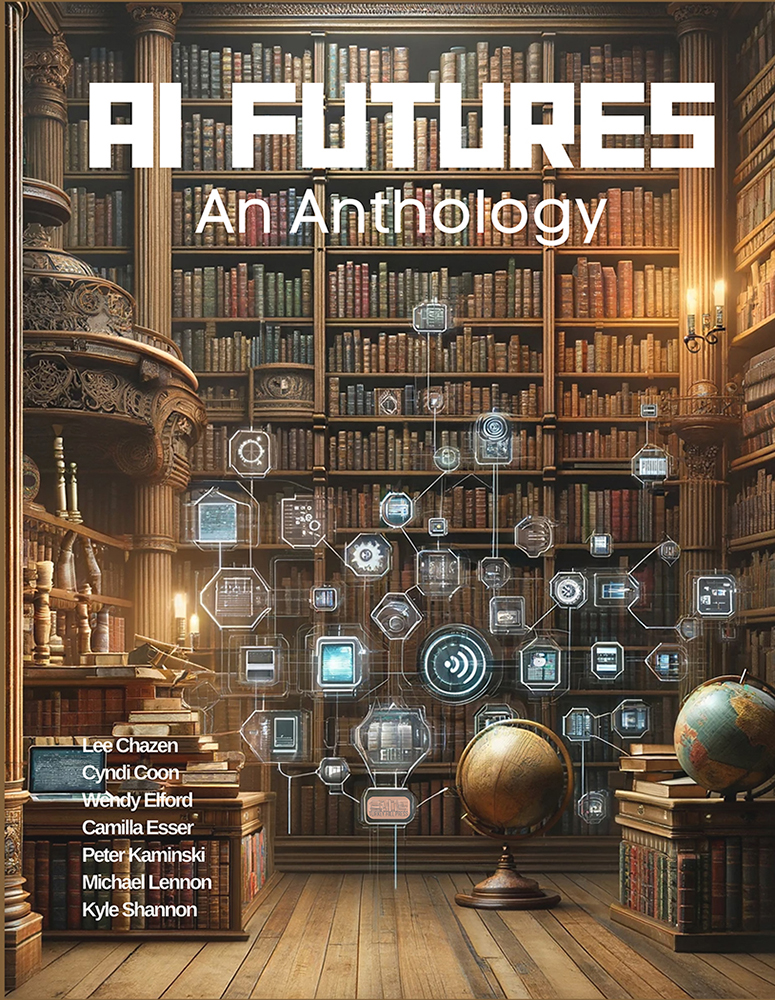
TI have been hanging out in AI play spaces where people from all different disciplines are gathering to connect and play, to experiment and to ask curious questions together. From one of these groups I came to meet seven amazing humans who are all on this journey and we decided to map it – together. We started by each writing down our experiences to date as we have engaged in AI. We create an anthology together as round one. It is called AI Futures An Anthology. Our next steps will be to video nd audio record our chapters and use those inside AI to create more things. It is an exciting play space to explore.n

As an Applied Experiential Futurist, I invite you to consider how AI can enhance your creative or professional work. Whether it’s through an AI-assisted design project, a data-driven marketing campaign, or an AI-curated educational curriculum, the opportunities are endless.

How will you embrace AI in your creative journey? Share your thoughts, and let’s continue to explore this exciting frontier together.

For more insights into the future of AI and creativity, visit Applied Futures Lab. To discuss these concepts further or get personalized guidance, connect with Cyndi Coon, on LinkedIn.

How To Build a GPT

Today, I was asked to provide a demo to a group on how to create a custom GPT using Open AI‘s ChatGPT-4. I put it up on YouTube so I could share it with folks. It’s a quick walk-through of the process of building, testing, adding knowledge, and saving public or private. If you are messing around in AI – ChatGPT isn’t the only game in town, but it is the easiest to date if you pay the twenty bucks a month for a subscription to Open AI. I am sharing this in case you are one of ‘the curious 18%’ of the population currently playing in Generative AI. If you are in the other 82%, bookmark this, and I’ll see you soon.