As generative AI becomes faster, more capable, and easier to rely on, creative work is quietly drifting away from the body. Ideas move from prompt to output with barely a pause, and the friction that once shaped judgment is treated as inefficiency.
This isn’t a crisis of tools. It’s a crisis of touch.
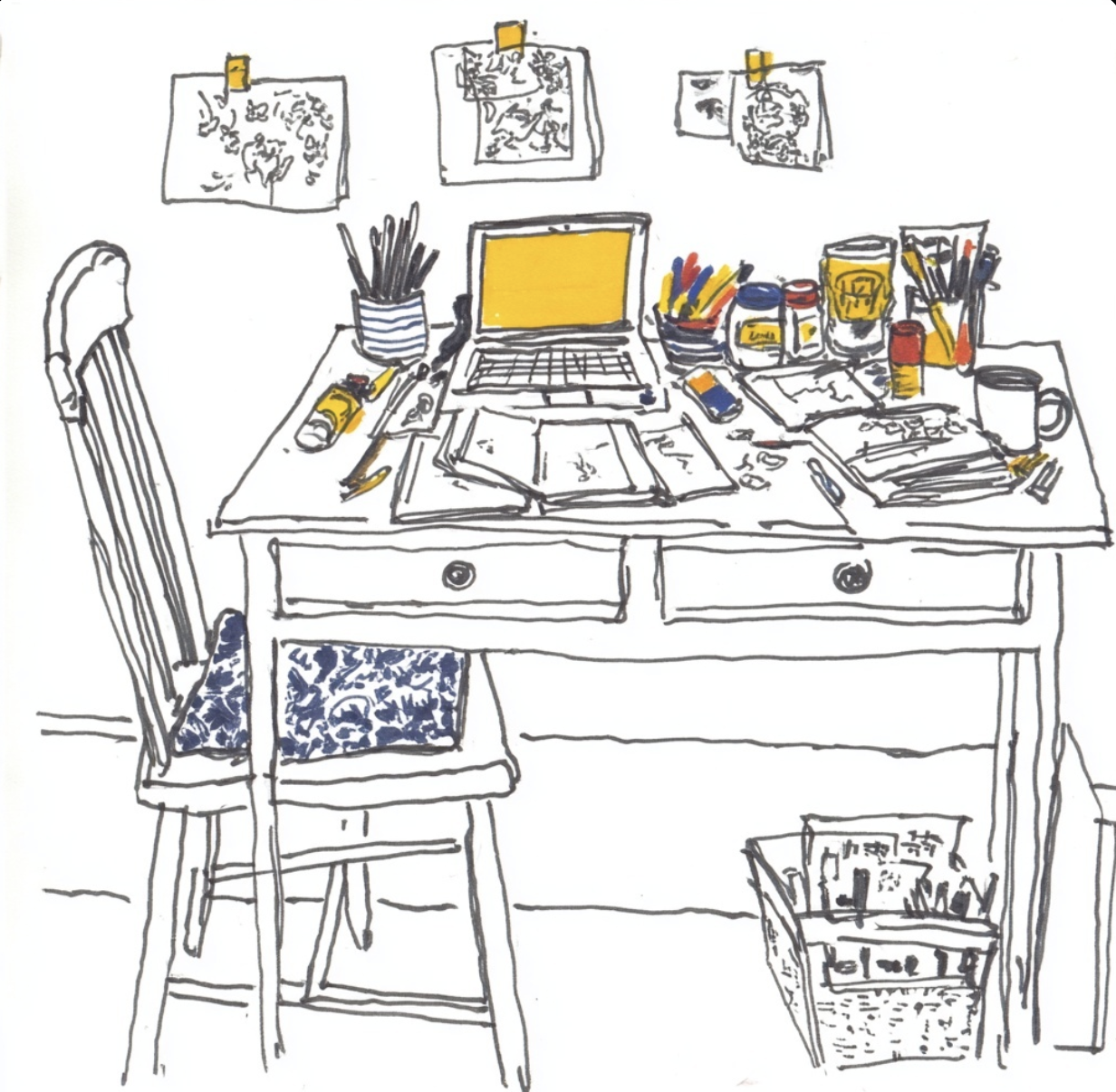
Creatives are being handed a false choice: embrace acceleration or stay grounded in material practice. But the work ahead isn’t choosing sides. It’s designing creative processes where AI and analog making are intentionally held in tension, with the hands playing a central role.
Because when creativity loses contact with the body, it loses its ability to care.
Hands Are Not a Nostalgia Act
Analog making is often framed as a sentimental return to the past. That framing misses the point entirely.
Hands-on practices are not about preservation. They are about perception.
When you sketch, write by hand, cut paper, or move objects around a table, your body becomes part of the thinking system. Resistance shows up. Fatigue appears. Mistakes surface. You slow down just enough to notice what doesn’t belong.
None of that is inefficiency. It’s information.
AI can generate options at scale, but it cannot feel the subtle signals that emerge through making: the hesitation before committing, the discomfort that signals misalignment, the satisfaction that tells you something has integrity.
Those signals live in the hands.
AI Expands Possibility. Hands Shape Meaning.
Generative AI is powerful precisely because it collapses time. It drafts, reorganizes, recombines, and proposes faster than any human can.
Used well, this is a gift. It opens creative space. It accelerates exploration. It helps us ask better “what if” questions.
But acceleration without embodiment is hollow.
In my own practice, AI is where possibility expands. Hands-on work is where meaning is shaped. I use AI to explore broadly, then step away from the screen to sort, edit, and decide using physical materials.
The sequence matters.
AI generates.
Hands select.
Judgment emerges in the space between.
Why Friction Is a Feature, Not a Flaw
Meaning doesn’t arrive fully formed. It appears through resistance.
The pause before a sentence resolves.
The moment when a sketch feels wrong.
The impulse to stop and rework something rather than push it through.
These moments disappear when creation becomes frictionless.
From a systems perspective, this isn’t a creative preference. It’s a feedback problem. When physical resistance is removed, we lose an entire layer of information. Discernment weakens. Care erodes.
Hands-on making restores those feedback loops.
Designing for Embodied Judgment
If AI is part of your creative process, design for embodiment on purpose.
Use AI generously in early exploration, but require that final decisions pass through a physical stage. Write the conclusion by hand. Lay concepts out as cards. Rearrange sketches on a table.
When reviewing AI outputs, notice your body. Tight shoulders. Wandering attention. Relief. Resistance. If something feels off, pause. That sensation is not noise. It’s signal.
And keep at least one analog practice non-negotiable. Drawing. Mapping. Longhand journaling. Anything that keeps your hands in conversation with your thinking.
That practice becomes your calibration tool.
The Work Ahead
Generative AI will continue to accelerate creative work. That isn’t the problem.
The risk is forgetting that judgment doesn’t live in prompts or outputs. It lives in bodies. In hands that know when to stop, revise, or walk away.
Human-centered futures won’t be built by faster generation alone. They will be shaped by people who still know how to make, feel misalignment, and choose deliberately.
Meaning isn’t generated.
It’s shaped.
Handled.
Tested.
And that work still begins with the hands.
 Lab5 BLOG