When Dr. Claire Nelson invited me to contribute a session to the IRIE MOON CONVERGENCE a 24-hour global Moonrise Watch Party following the Moon across six waves, from Oceania to Hawaii – I felt the invitation before I fully understood what I wanted to create.

I didn’t want to give a presentation about the future. I wanted people to experience themselves inside one.
The seed. My starting point was an area close to my heart: menopause as a creative threshold rather than a decline. What if the pause isn’t empty, but the clearing in which a different future can finally be heard? The Moon offered the language for it — it changes without disappearing, moves through shadow and light without apologizing for either. Change is not the opposite of wholeness.
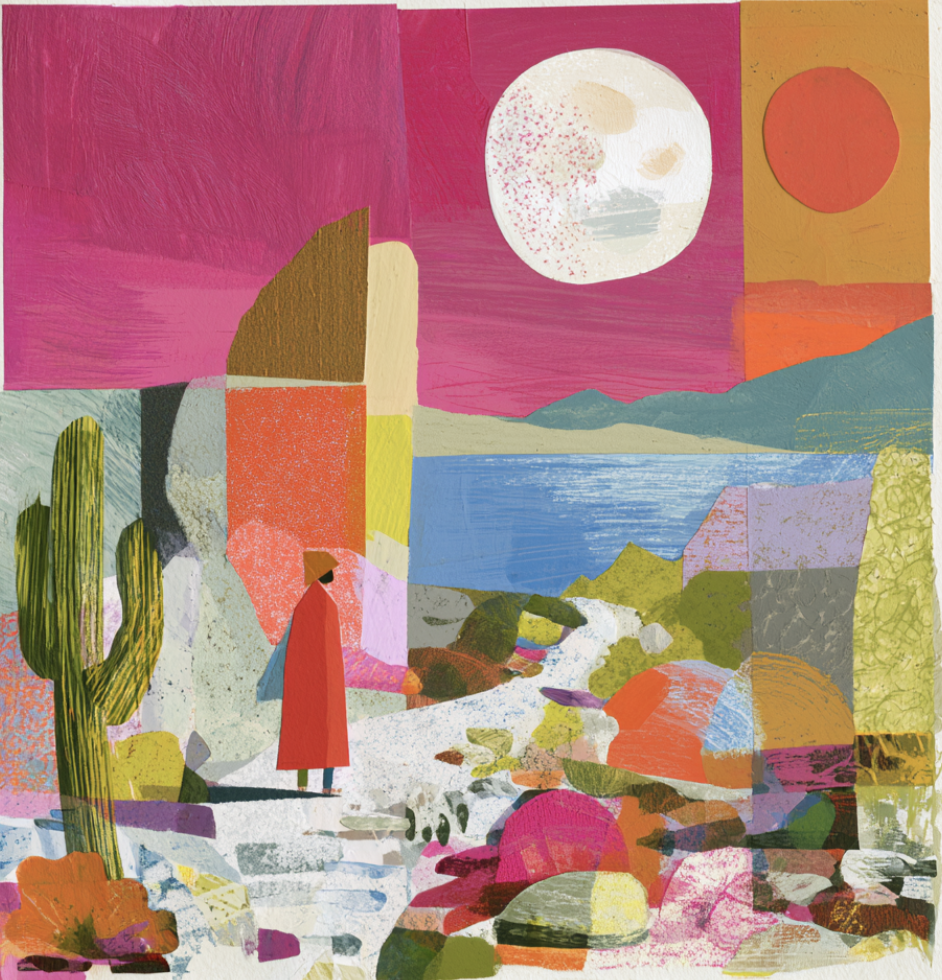
I wanted the ritual to stay open beyond that one lens, though — to anyone who wanted to encounter the Moon through astronomy, memory, grief, ecology, or wonder. One Moon doesn’t make us identical. It shows us that difference and connection can coexist.
The arc. The session — Under One Moon: A Ritual for Creative Futures — moved participants through Arrive → Release → Imagine → Create → Commit → Connect: a meditation, an original poem, and a hand-drawn Moon Tile capturing what they’d release, what was emerging, the future they wanted to help create, and one small first step.
Futurecasting. I used my practice of Futurecasting to structure the journey — not prediction, but agency: the future isn’t a destination rushing at us, it’s something we participate in shaping. I asked participants to imagine one ordinary moment ten years out, July 30, 2036, and to notice what was different — not in abstractions like “greater belonging,” but in a scene: an elder teaching children beneath the night sky, a community restoring a wetland before a Moonrise celebration. The future becomes human when someone is there.
Then the key question: What began in 2026 that helped this future become possible? That’s backcasting — turning “what do I hope happens” into “what has to start now.”

The poem. I wrote “Moonpause,” returning to that first seed:
There comes a season when a woman no longer measures herself by what arrives, what leaves, what blood remembers.
The Moon Tile. Participants drew a circle and moved through four spaces: Moonshadow (what I release), Moonrise (what is emerging), Moonseed (the future I want to help create), and Moonplant — completing the sentence Before the Moon completes another cycle, I will… Small enough to begin, meaningful enough to matter.
Closing. Hand on their tile, each participant spoke the ritual back to themselves — honoring what had been, welcoming what was emerging, committing to the intention, beginning with one step. Three breaths: one for ourselves, one for someone elsewhere under the same Moon, one for the generations who inherit what we shape now.
The Moon doesn’t rush through its phases. We don’t have to rush through ours.
Your invitation. Wherever you’re reading this, look up — even if the Moon is hidden by clouds or daylight, it’s there. Ask: What am I ready to release? What’s emerging? What future do I want to help create? Then finish the sentence: Before the Moon completes another cycle, I will…
Don’t wait for the perfect answer. One honest beginning is how futures take root.
One Moon. Many imaginations. A future shaped together.
Cyndi Coon is a time traveler and rule-bender, nerding out for good using data, science and curious questions as an Applied Futurist, author, creative, ecosystem builder, facilitator, producer, researcher, storyteller and publisher for: governments, the military, higher education, private partnerships, enterprise, and industry. Cyndi is the Founder and Principal Futurist at Applied Futures Lab, Founder of Laboratory5, and Co-founder of Arizona State University’s Threatcasting Lab and is the co-founder at Threatcasting.ai. Cyndi is the author of Future AI Mindset, co-author of Threatcasting (2021), Futurecasting (2026) and the author of numerous reports, articles and book chapters. Founder and Publisher at Turkey Hill Press.
She is an Affiliate at the Center for Emergency Management & Homeland Security. Chief Media Officer for Content Evolution. She leads the i4j (global innovation for jobs workforce) and Coolabilities communities, promoting inclusive and forward-thinking solutions. She is a Web 3 advisor. Connect with Cyndi Linktree