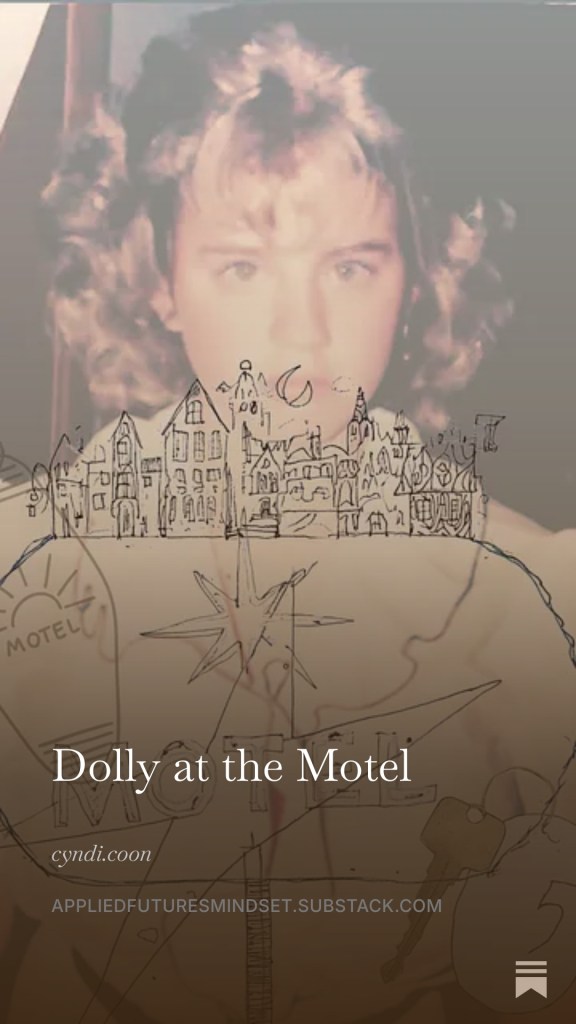
When I was ten years old, living with my family in a Motel 6 in Texas, Halloween became a much bigger deal than it probably should have been.
I wanted a real costume. The kind the other kids at school had. Annie wigs. Garfield whiskers. Strawberry Shortcake everything.
We didn’t have the money for any of that.
What I did have was an older sister with an idea, a borrowed ruffled dress, a grey thrift-store wig, a lot of makeup and, eventually, two strategically placed balloons.
And just like that, I became Dolly Parton.
Or at least ten-year-old me was completely convinced I had.
What I remember most now isn’t really the costume. It’s the Motel 6. It’s my sister showing up early to help me get ready. It’s my dad finding a wig at a thrift store on his lunch break. It’s searching the room for 35 cents for the bus. It’s trick-or-treating door to door among people who weren’t expecting children to show up at all.
And it’s a group of waitresses at the motel diner giving my brother and me cobbler and ice cream because they didn’t have any Halloween candy.
Years ago, I wrote that memory down and called it “Dolly at the Motel.”
With Dolly Parton’s passing this week, I found myself thinking about that story again and about what Dolly represented to a ten-year-old girl who didn’t have much but had absolutely no shortage of imagination.
So I pulled the piece back out.
It’s funny. It’s uncomfortable in places. It’s very much a story about my childhood. And somewhere inside all of that, it’s also about creativity, pride, family and figuring out how to make something spectacular out of whatever happens to be lying around.
Cyndi Coonis a time traveler and rule-bender, nerding out for good using data, science and curious questions as an Applied Futurist, author, creative, ecosystem builder, facilitator, producer, researcher, storyteller and publisher for: governments, the military, higher education, private partnerships, enterprise, and industry. Cyndi is the Founder and Principal Futurist atApplied Futures Lab, Founder ofLaboratory5, and Co-founder of Arizona State University’sThreatcasting Laband is the co-founder atThreatcasting.ai.Cyndi is the author ofFuture AI Mindset, co-author ofThreatcasting(2021), Futurecasting (2026) and the author of numerous reports, articles and book chapters. Founder and Publisher at Turkey Hill Press.
Twenty-five years ago, Laboratory5 began as an experiment in making things by hand.
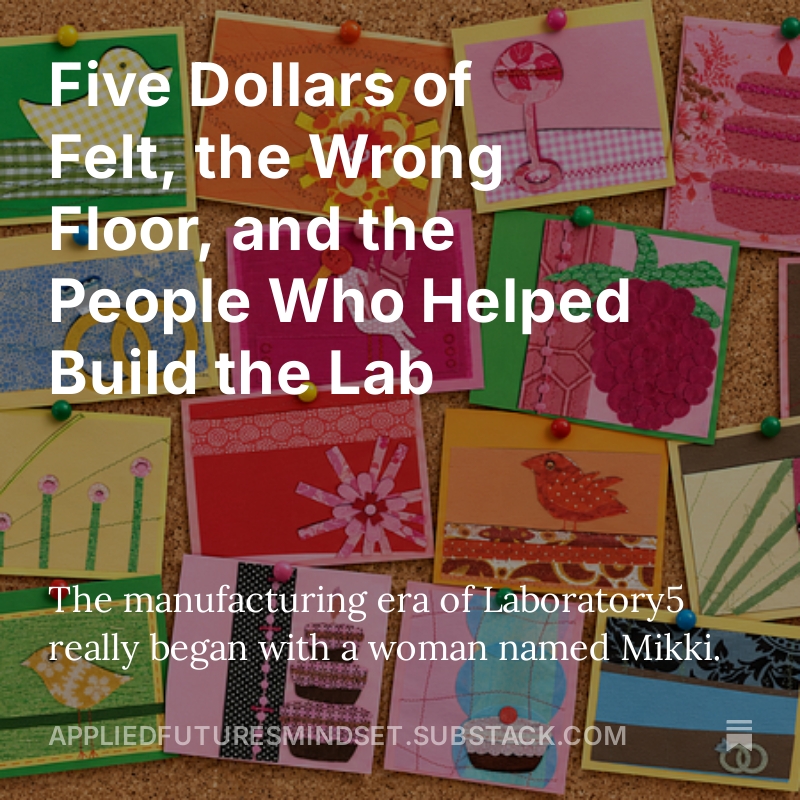
Before the futurist work, before the labs, before the consulting, workshops, research and all of the strange and wonderful places the company would eventually go, there was paper. There was felt. There were die presses, glue, stacks of cards, orders to fill and a house in Tempe slowly turning into a manufacturing operation.
There was also a five-dollar box of craft felt from a flea market that helped define the look of the company.
But when I look back now, that era is not really about the products.
It is about the people.
The Arizona State University board member who asked me about my little-girl dream. The friend who seated me beside exactly the right person at a dinner party. The stationery company owner who invited me to walk the National Stationery Show in New York. The stranger who overheard me telling my husband I was completely out of my league and informed me that I was, quite literally, on the wrong floor.
That elevator ride changed everything.
The next year, Laboratory5 had its own booth at the National Stationery Show. From there came showroom reps, museum stores, independent boutiques, national media, TV appearances, a lot of felt, and eventually an opportunity with Target that forced me to decide what kind of company I actually wanted to build.
This second piece in my Laboratory5 25th anniversary series is about that chapter, but mostly it is about the humans who helped shape it.
It is also about something I understand much better now: sometimes the dream is not supposed to keep getting bigger. Sometimes you get to live it fully, recognize that you did what you came to do, and move on to the next thing.
Cyndi Coonis a time traveler and rule-bender, nerding out for good using data, science and curious questions as an Applied Futurist, author, creative, ecosystem builder, facilitator, producer, researcher, storyteller and publisher for: governments, the military, higher education, private partnerships, enterprise, and industry. Cyndi is the Founder and Principal Futurist atApplied Futures Lab, Founder ofLaboratory5, and Co-founder of Arizona State University’sThreatcasting Laband is the co-founder atThreatcasting.ai.Cyndi is the author ofFuture AI Mindset, co-author ofThreatcasting(2021), Futurecasting (2026) and the author of numerous reports, articles and book chapters. Founder and Publisher at Turkey Hill Press.
Reposting a piece I wrote about my mom, brother and our road trip this summer (2026)
There are moments when the future arrives without fanfare.
Not in the form of some spectacular technological breakthrough or a dramatic life event, but as a sentence spoken quietly in a doctor’s office.
“Go now.”
Not next year. Not when it’s more convenient. Not after everyone’s schedules clear.
Go now, because next year she may not be able to make this trip.
As an applied futurist, I spend my life helping organizations think about tomorrow. I study change, emerging behaviors, and the signals that shape what comes next. But every once in a while, life reminds me that the future isn’t something waiting out there.
Sometimes the most important future you’ll ever build is the one you choose to live today.
My mother, ‘Mama Rose,’ as everyone calls her, had only one request for her 80th birthday. She wanted to go back to Drummond Island, Michigan. Back to where she and my dad honeymooned in 1964. Where my siblings and I spent summers camping, catching sucker fish by hand, exploring the woods, and believing those endless Michigan days would last forever.
My father has been gone for ten years. Dementia took him from us in the summer of 2016.
Now, dementia is beginning to steal pieces of my mother.
Not all at once.
Just enough to remind us that memory isn’t permanent.
Some days on our trip she didn’t know where she was. She’d ask if we’d eaten, even though lunch had been an hour before. More than once she reached into her purse, expecting to find the wallet she’d carried for decades. Instead she found only the things that still matter to her: the latest Amish Hearts novel she was reading that we refer to as her Amish porn; a small notebook, and a couple of pens.
Her wallet lives with my brother now.
So do her medications. He quietly hands them to her twice a day. He watches her water intake. He hides the ibuprofen until it’s time. He gently reminds her where they are, what day it is, and that she’s having a wonderful adventure.
My older brother Tim is a disabled veteran. He’s also my mother’s full-time caregiver. Watching the tenderness between them became one of the unexpected gifts of this journey.
Road trips distort time
Days become measured not in hours, but in state lines, gas stations, ferry crossings, ice cream cones, remember-when stories and whatever ridiculous thing makes everyone laugh at the next stop.
We didn’t rush.
That was the point.
Mom and Tim left Apache Junction, Arizona, where my parents settled after leaving Michigan more than twenty years ago, and where my brother eventually joined all of us to build a life out West. The next afternoon they pulled up the long dirt mountain road in northern New Mexico, where I live tucked amongst art-making, nature, and animals. We loaded the last bags into the car, and the three of us pointed the car north.
Almost immediately, the trip settled into its own rhythm.
Music from our youth
Road trip snacks
Always a fresh, crisp Diet Coke for Mama Rose
Bathroom breaks
Colorado welcomed us with mountains and hot springs near Great Sand Dunes National Park. We soaked our bones before spending the night in Glen Eyrie Castle outside Colorado Springs because, honestly, if you’re turning eighty, you deserve to sleep in a castle at least once.
The next morning we traded mountains for prairie.
Kansas unfolded exactly as Kansas should: endless sky, grain elevators, weathered barns, and highways that somehow invited conversation. Stories surfaced that none of us had thought about in years. The kind of stories that only appear when no one is in a hurry.
Nebraska rolled into Iowa almost without announcement. Cornfields replaced mountains. Windmills replaced rock formations. We wandered into little towns, stopped at roadside attractions, browsed thrift shops, and never passed a free little library or a yard sale without a u-turn. Afternoons became unexpected treasure hunts that produced absolutely nothing we needed and everything we enjoyed.
Eventually we reached Wisconsin. Instead of driving around the lake, we drove onto the SS Badger in Manitowoc, Wisconsin. Watching our car disappear into the belly of the ship felt victorious because we had reached a planned destination on the trip. We climbed onto the deck and spent four hours crossing one of the Great Lakes.
There is something magical about arriving in your home state by water.
Michigan doesn’t slowly appear. It rises.
At first it’s just a dark line on the horizon. Then trees. Then dunes. Then rock formations. Then the shoreline we’ve known our whole lives, the one our family’s roller-skating rink used to perch on. It felt like returning to a conversation we’d stepped away from years ago.
We celebrated Mom’s eightieth birthday in Muskegon, Michigan, with family and friends that feel like family. She felt loved.
We went wandering north along M-22, one of the most beautiful drives anywhere in the country. Every curve – another postcard: vineyards, cherry orchards, little harbor towns, and stretches of blue water that looked more like an ocean than a lake. We spent time with old friends on benches looking out at the long stretches of blue.
Arriving in Traverse City, it was buzzing with the National Cherry Festival, but our first stop wasn’t one of the attractions. It was Dockside Market. Every summer since the 1980s, Dad bought cherry-smoked turkey jerky there. Not because it was famous, but because it had become one of those family traditions no one questioned. Some traditions don’t need improving. They simply need repeating. So we bought the jerky. Dad wasn’t there to eat it. But somehow, he was.
We crossed the Mackinac Bridge with the same sense of anticipation we always had as kids, knowing the Upper Peninsula meant freedom, woods, beaches, and another world entirely.
As we drove around the U.P., we found ourselves watching not one but three of those classic small-town Independence Day parades where volunteers tossed candy from floats.
Not just any candy.
Tootsie Rolls.
Mom’s favorite.
By the end of all the parades, we had collected an entire bucket of them for her and all the other candy was handed over to a little toddler at the last parade of the day. He was thrilled.
She smiled like a little girl.
That night in Sault Ste. Marie, we watched Fourth of July fireworks explode over the St. Mary’s River while Canada shimmered just across the water.
Then came the day we’d all been waiting for. Drummond Island.
Mom wasn’t looking for a new experience. She wanted to see what remained.
Arriving at Detour, Michigan, crossing Lake Huron on the ferry. The roads on the island that led to connection points she could easily recall.
The shorelines.
The campsites.
She wanted to see them one more time while she still could. The places where she had fallen in love. The places where she had raised a family. The places where she built a lifetime of memories before they are slowly carried away.
After leaving the Upper Peninsula, we hugged Michigan’s eastern shoreline, following historic US-23 and M-25 through beach towns and quiet harbors. We stopped for ice cream because it was summer; always Boston Coolers for me because when in Michigan you drink Vernors in all forms! We drove through farm country for hours, laughing because we were only slightly nervous about where the next gas station was. We talked about childhood adventures, our dad, our futures, and Mom’s declaration that she plans to live to be 107.
I sincerely hope she’s right.
Eventually we reached Detroit, where Tim checked off his own list of places he’d always wanted to see, from sports venues to sculptures, and the new Gordy Howe International Bridge changing the skyline of a city from our childhood.
Then another chapter quietly opened.
My youngest daughter, a fresh high school graduate marking the beginning of my own empty-nester season, flew into Detroit to meet me. Mom and Tim would continue their journey back to Arizona. My daughter and I would begin another adventure together.
In a street outside the hotel, I hugged my brother; he cried, and I cried. Then I hugged my mom, tight. I thanked them both for giving me one of the greatest gifts I’ve ever received.
People often ask me what being a futurist has taught me. For years I’d answer with human-centric foresight for imagining what comes next.
This trip reminded me what’s really real. The pause.
The future isn’t built by constantly looking ahead. It’s built by fully inhabiting the present while you still can. We spend so much time planning for tomorrow that we forget tomorrow is made from today’s ordinary moments.
A ferry ride across Lake Michigan.
Hot springs and a castle in Colorado.
Cherry-smoked turkey jerky bought from the same market your dad visited 62 years ago.
A bucket full of Tootsie Rolls collected at a small-town parade.
A purse that no longer carries a wallet but still carries what matters.
A son quietly handing his mother her medicine.
An eighty-year-old woman returning to the island where her story began before memory slowly carries pieces of it away.