Gravitational Waves Discovered, Confirming Albert Einstein’s Theory

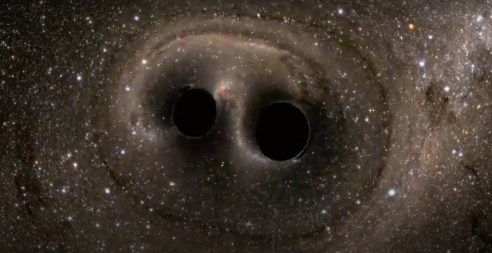
black-hole collision

Albert Einstein presented his theory of relativity in 1915.  He predicted that the collision of massive objects would send out gravitational waves.  Scientists just discovered that about a billion years ago, two black holes collided with each other and the energy is still spreading out.  The gravitational wave compresses space in one direction and stretches it in another.  Read more about it and watch this video by the New Your Times.

Visit our website: Laboratory5       Follow us on Twitter: @lab5     Become a fan on Facebook: Laboratory5
Contact Us at anytime – we’d love to hear from you

Happy Birthday Charles Darwin

charles-darwin-web

Happy birthday to Charles Darwin, famed naturalist and
geologist. And, incidentally, happy Darwin Day! This annual
celebration commemorates not only Darwin’s birthday, but also
his contributions to science and evolutionary theory. Darwin Day
was informally founded in 1909 when over 400 scientists met to
honor him and to discuss recent discoveries and related
theories.

Illustration by Amy DeCaussin.

Visit our website: Laboratory5       Follow us on Twitter: @lab5     Become a fan on Facebook: Laboratory5
Contact Us at anytime – we’d love to hear from you

Underwater Art Museums – Making a difference in conservation

Sculptor Jason deCaires Taylor places his work underneath the ocean’s surface in locations all over the world.  The exhibits are beautiful and provide a place for ocean life to thrive, but the advantages of his work expand beyond the tiny organisms growing on them.

Taylor’s sculpture park “Ocean Atlas” in the Bahamas drew attention to a nearby leak at an oil refinery.  The pressure from the international news media influenced the government to allocate 10 million dollars towards cleanup.  His park in Granada provided a reason for the government to create a designated area where marine life is protected.  Entrance fees to the park fund park rangers who manage fishing quotas and tourism.

The underwater sculpture parks are called museums to help people view the ocean as sacred.  When we hold something sacred, we cherish and protect it.  A museum is a place of preservation, conservation and education.  It becomes a designated point of interest where people can learn about the ocean and participate in its survival.

The work of Jason deCaires Taylor is the perfect combination of art and science that is playing a pivotal role in positive changes to the environment.

Posted by Amy DeCaussin.

Laboratory5 Inc. is a small business based in Tempe, Arizona

Visit our website: Laboratory5       Follow us on Twitter: @lab5     Become a fan on Facebook: Laboratory5
Contact Us at anytime – we’d love to hear from you