The discussion is loud, fast, and often technical. New tools appear every week. Headlines promise transformation, disruption, automation, acceleration.
But the deeper work is quieter.
It lives in how we think.
Over the past few years, I’ve been studying how people interact with intelligent systems. The same technology lands in different hands and produces completely different outcomes. Some people feel overwhelmed. Others find creative momentum. Some freeze. Others experiment.
The difference is rarely technical skill.
It’s mindset.
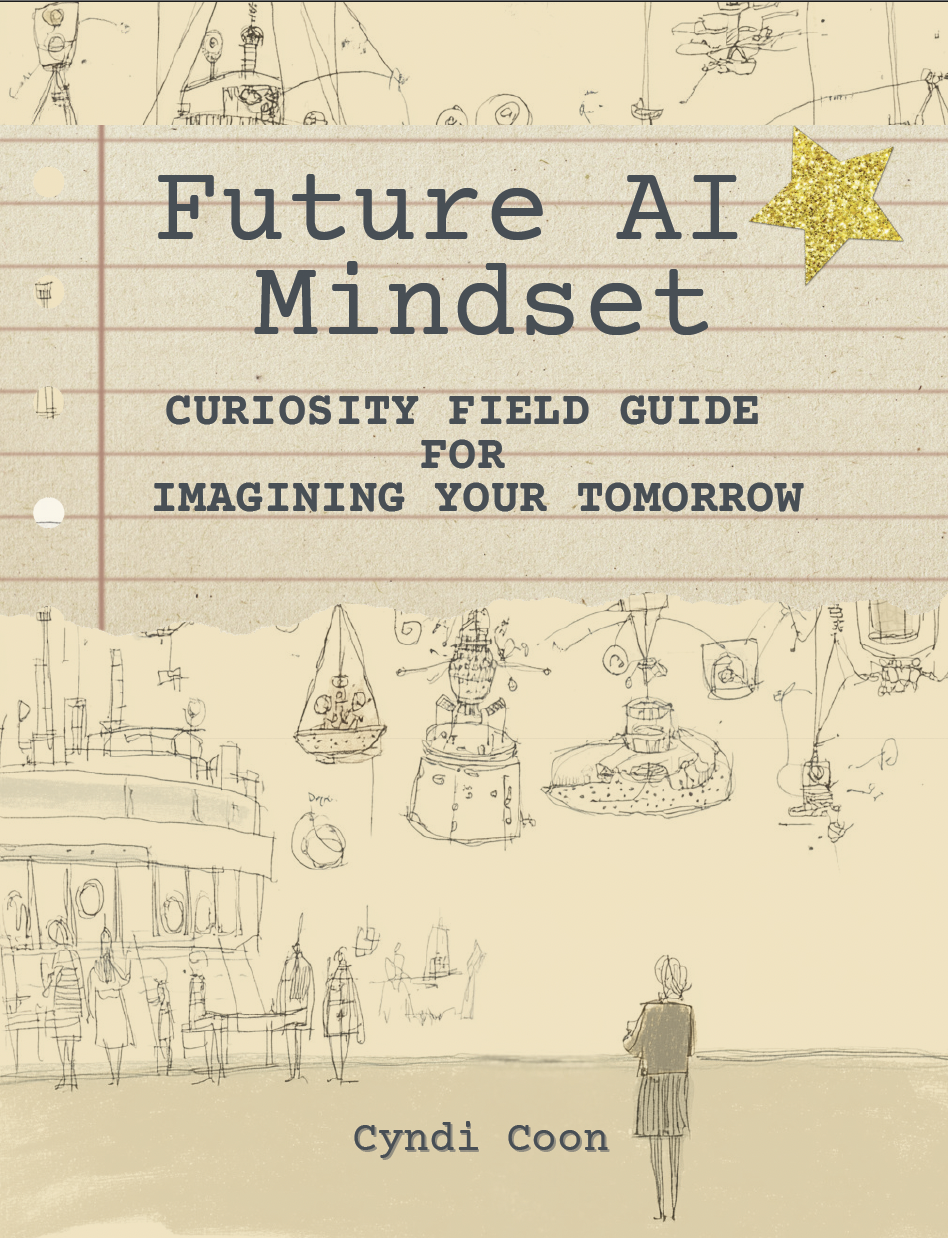
That realization became the foundation for my new book, The Future AI Mindset: Curiosity Field Guide for Imagining Your Tomorrow. The book explores the cognitive habits that allow people to navigate complex, learning systems without becoming reactive or overwhelmed.
But something became clear while I was writing it.
Reading about a mindset is helpful.
Practicing it together is transformative.
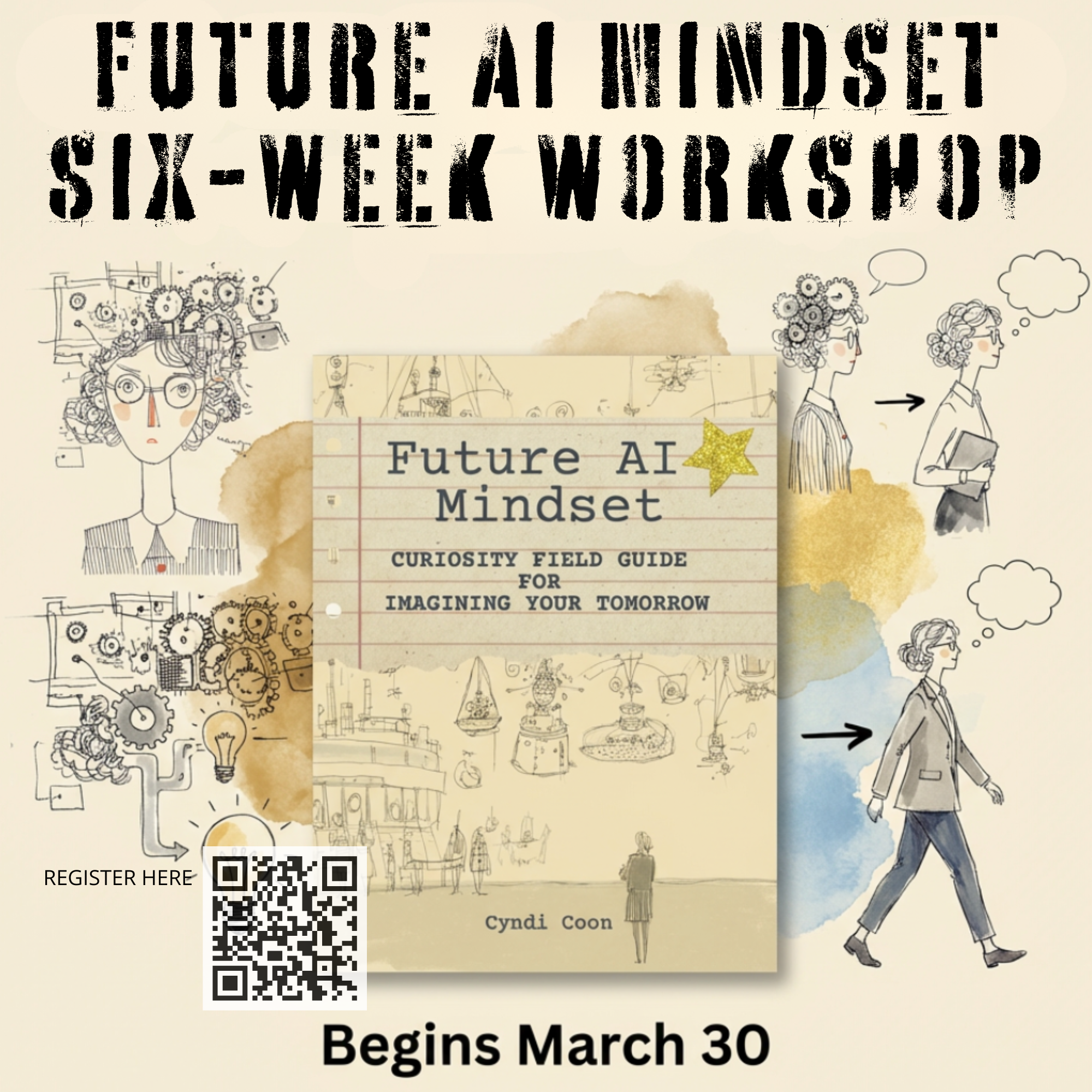
That’s how the Future AI Mindset six-week workshop came to life.
Why This Workshop Exists
If you’ve been paying attention to the conversation around AI, you’ve probably noticed something strange.
Artificial intelligence is often described as a technological shift. In reality, it is also reshaping how we think, decide, collaborate, and imagine consequences across time.
When systems can generate ideas, synthesize information, and participate in creative processes, our relationship with knowledge changes. Our relationship with uncertainty changes. Even our relationship with time shifts.
The challenge is not simply learning new tools.
The challenge is learning how to think clearly inside systems that keep evolving.
The Future AI Mindset workshop was designed to address that challenge. It translates the ideas from the book into a structured thinking practice.
This approach is grounded in my work as an applied futurist and in the foresight methods I helped co-create over the years: Threatcasting, Futurecasting, and Applied Experiential Futures. These methods were developed in environments where imagination must be disciplined and decisions carry real consequences.
Enterprise strategy. Government planning. Defense scenarios. Higher education. Innovation labs.
The goal in those environments is not prediction. It is orientation. Helping people think clearly in the presence of uncertainty.
The workshop brings that same discipline into our relationship with AI.
What We Explore Together
The six-week program is designed as a live thinking lab.
Each week we explore a different dimension of the Future AI Mindset framework, combining discussion, reflection, and practical exercises drawn directly from the book.
Participants will examine questions such as:
How does AI reshape cognition and creativity?
What does collaboration look like when some collaborators are intelligent systems?
How do we maintain judgment when machines produce convincing outputs?
How do we think across time when technological change accelerates?
Instead of rushing toward answers, we practice structured curiosity.
We explore scenarios. We examine assumptions. We learn to hold multiple possible futures at once without collapsing into certainty.
These are skills futures thinkers have practiced for decades, and they are becoming increasingly valuable in AI-integrated environments.
What You Will Build
By the end of the six weeks, participants leave with more than notes or ideas. They will have built a set of practical tools they can continue using.
These include:
A personal Future AI Mindset statement that clarifies how you want to engage with intelligent systems.
An Applied Futures Map that connects present decisions with longer-term possibilities.
A backcasting pathway, working from a future you want toward actions you can take today.
A decision anchor that helps guide choices in moments of uncertainty.
And perhaps most important, a personal thinking practice that can travel with you into your work, teams, and projects.
These artifacts are designed to remain useful long after the workshop ends.
Who This Is For
This workshop is designed for people who sense that AI is not just changing technology. It is changing the terrain we think and act within.
Leaders making strategic decisions without complete information.
Educators preparing students for futures we cannot fully describe yet.
Researchers, designers, and builders working inside emerging systems.
Curious professionals who want to remain intentional rather than reactive.
If you have ever felt the acceleration and thought, I need to be thoughtful about how I navigate this moment, you are exactly the kind of person this workshop was designed for.
The Structure
The program runs for six weeks and meets live once a week.
Start date: March 30, 2026
Session length: One hour each week
Format: Live virtual sessions with recordings available
Sessions meet Mondays at:
2 PM Pacific
3 PM Mountain
4 PM Central
5 PM Eastern
22:00 GMT
Between sessions, there will be small exercises designed to help integrate the ideas into everyday thinking.
Nothing overwhelming. Just enough to move from theory into practice.
A Different Kind of AI Conversation
Many AI conversations focus on capability.
This workshop focuses on orientation.
How we think.
How we decide.
How we imagine consequences across time.
The tools will keep evolving. That part is inevitable.
But the mindset we bring to those tools will shape how we use them, how we design with them, and how we guide the systems we are building.
The Future AI Mindset workshop is an invitation to practice that way of thinking together.
Six weeks of thoughtful exploration.
Six weeks of strengthening cognitive habits for an intelligent age.
If that sounds like a useful experiment, I’d be glad to have you join us.
Workshop registration is available HERE
And if someone comes to mind who might enjoy spending an hour a week thinking about the future together, feel free to share it with them.
The future is not something we simply wait for.
It is something we learn to think into.
Cyndi Coon is a time traveler and rule-bender, nerding out for good using data, science and curious questions as an Applied Futurist, author, creative, ecosystem builder, facilitator, producer, researcher, storyteller and publisher for: governments, the military, higher education, private partnerships, enterprise, and industry. Cyndi is the Founder and Principal Futurist at Applied Futures Lab, Founder of Laboratory5, and Co-founder of Arizona State University’s Threatcasting Lab and is the co-founder at Threatcasting.ai. Cyndi is the author of Future AI Mindset, co-author of Threatcasting (2021), Futurecasting (2026) and the author of numerous reports, articles and book chapters. Founder and Publisher at Turkey Hill Press.
She is an Affiliate at the Center for Emergency Management & Homeland Security. Chief Media Officer for Content Evolution. She leads the i4j (global innovation for jobs workforce) and Coolabilities communities, promoting inclusive and forward-thinking solutions. She is a Web 3 advisor. Connect with Cyndi Linktree

 Lab5 BLOG