On November 1st, I made a decision that changed how I relate to my own labor.
I wasn’t looking for a better to-do list or a smarter app. I wanted a true reset. Not a cosmetic one, but a structural one. I needed to see what I was carrying and to stop pretending that all work is light, fast, or invisible once it’s done.
So I set aside a full weekend and did something very simple.
I externalized everything.
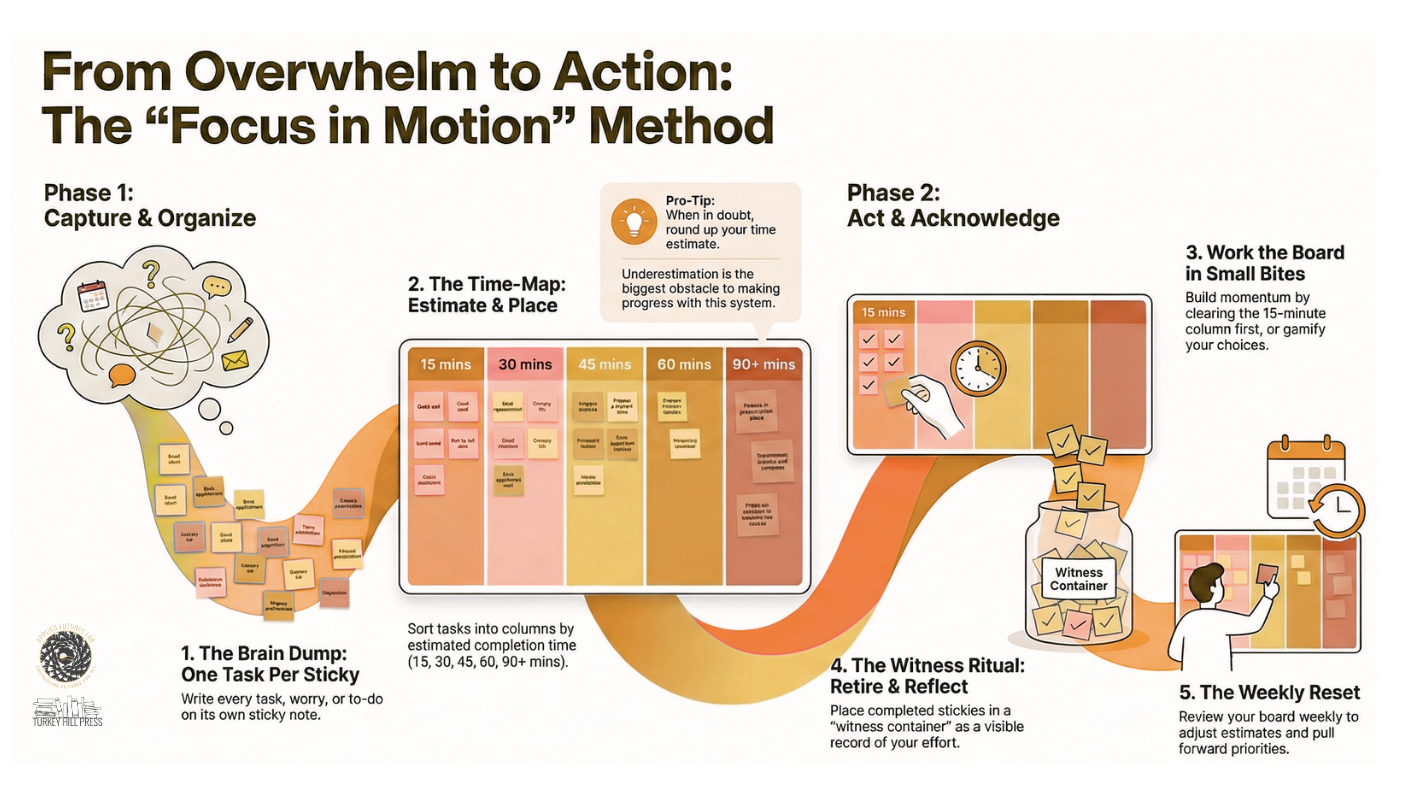
Step One: Get It Out of Your Head
I started with one rule: one task per sticky note.
Every task I could think of went onto its own piece of paper. Not just work tasks, but home repairs, family logistics, year-end responsibilities, creative projects, community commitments, and the quiet maintenance tasks that keep life running.
If it lived in my head, it qualified.
The goal wasn’t organization yet. It was honesty. I kept going until my brain got bored, which turned out to be a reliable signal that I’d reached the bottom of the mental bucket.
Step Two: Map Time, Not Importance
Next, I drew vertical columns on my whiteboard and labeled them with real-world time estimates:
15, 30, 45, 60, and 90+ minutes.
Each sticky found a home based on how long the task actually takes, not how long I wished it would take. When I hesitated, I rounded up. Underestimation is where momentum goes to die.
This step changed everything. Suddenly, my workload wasn’t abstract. It was measurable. I could see where my time was going and why certain days felt heavier than others.
Step Three: Work in Small, Honest Bites
From there, I worked the board in small increments.
Some days I cleared the 15-minute column to build momentum. Other days I gamified the process by drawing a random time card and choosing a task from that column. The method didn’t care how I chose. What mattered was consistency.
This wasn’t about optimization. It was about alignment between energy, time, and reality.
Step Four: Witness the Work
Here’s the part that shifted my relationship with effort.
When I completed a task, I didn’t throw the sticky away.
I placed a small trash bucket on my desk and committed to dropping each finished sticky inside. I called it my witness container.
The bucket began to fill.
Each sticky became proof of attention spent, decisions made, and care applied. Not just productivity, but presence. The work didn’t disappear the moment it was done.
Step Five: Weekly Reset, Not Endless Push
Once a week, I stood at the board and adjusted.
Tasks that took longer than expected moved columns. Stickies that hid multiple steps got split. Priorities for the next seven days came forward.
Patterns became obvious. What I avoided. What drained me. What consistently required more time than I admitted.
The board became a feedback loop instead of a guilt machine.
Why This Worked
Motion became my work for staying focused.
Focus in Motion isn’t a productivity system. It’s a witnessing practice. It turns invisible work into physical artifacts. It replaces vague, overwhelming feelings with a navigable map. It honors effort without asking for hustle or self-judgment.
Most importantly, it restores a sense of agency over time. You don’t disappear into your work. You can see it, touch it, and account for it.
As the year wound down and the bucket filled, I was left with something rare: a grounded sense of what I’d actually done, not just what remains.
That clarity is the foundation for any true fresh start.


 Lab5 BLOG