Hospital uses art lessons to improve medical practice

the-art-of-healing

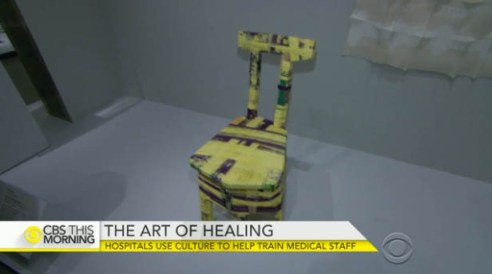
An innovative program at Boston’s Brigham and Women’s Hospital uses art to help physicians focus on the art of healing. (Click here to view the CBS video, Dr. Tara Narula reports.)  Members of the integrated teaching unit (ITU) attend sessions at Boston Museum of Fine arts where they are learning to soften the hard science of medicine by strengthening interpersonal skills.  The program is bringing humanities back into the healthcare curriculum, a core value that has been missing for the last 50 years.

The experience at the museum has a unique advantage above other types of activities such as attending a ball game, or having a staff party. Art takes everyone out of their comfort zone.  Participants are asked to observe and talk about the artwork.  Discussions promote collaboration and team building.  As a result, they become better at communicating, problem solving, thinking outside of the box and appreciating different perspectives.  These are all great skills that enhance the ability to diagnose as well as treat a patient.  According to this CBS video segment, the program is showing great improvements in the care given at the hospital.

Posted by Amy DeCaussin.

Laboratory5 Inc. is a small business based in Tempe, Arizona

Visit our website: Laboratory5       Follow us on Twitter: @lab5     Become a fan on Facebook: Laboratory5
Contact Us at anytime – we’d love to hear from you
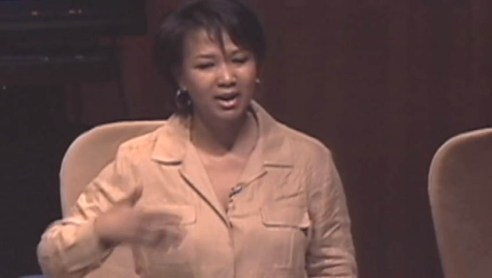
 

Teach Arts & Sciences Together – Astronaut Mae Jemison

In this video, Dr. Mae Jemison, physician and former NASA astronaut, talks about what is critical to a better future–and by future, she means, “In the year 2015, and the year 2020, 2025, the world our society is going to be building on, the basic knowledge and abstract ideas, the discoveries that we came up with today.”  This TED Talk was recorded in 2002, however her speech seems to resonate more than ever with what is currently going on in the world.  So listen up, all you societal contributors!  This message is important and should be applied today as we work to build our legacy for tomorrow.

The ideology that science and art are separate–this polarization, hinders the ability to create progress, experience and humanity for the future.  Dr. Jemison argues that they are “manifestations of the same thing.”  She goes on to say, “Science provides an understanding of universal experience and arts provides an understanding of a personal experience.  They are all part of us.”  Art is thought to be intuitive, and science is considered analytical.  Art is also analytical. According to Dr. Jemison, the ability to launch the shuttle is derived from the same place as choreographing a dance.  When choreographing a dance, upon hearing the music, one might first intuitively come up with an expressive movement.  The creation is then analyzed and refined to convey the right communication to the audience.  A scientist can think of an equation first, and then analyze it to see if it will work.

Why is it so important for everyone to understand that these two subjects coexist?  It effects how we think, how we learn, and how we create and contribute to society.  Dr. Jemison explains, “My personal issue for the future is really about integrating the intuitive and analytical.  The arts and scientists are not separate.  I like to think of ideas as potential energy.  They are really wonderful but nothing will happen without risking putting those ideas into action.  The three questions of greatest concern “is it attractive (intuitive), is it amusing (analytical) and does it know its place (balance)?”

Written by Amy DeCaussin

Director of Projects & Social Media

Laboratory5 Inc. is a small business based in Tempe, Arizona

Visit our website: Laboratory5       Follow us on Twitter: @lab5     Become a fan on Facebook: Laboratory5
Contact Us at anytime – we’d love to hear from you
Bringing Physical Human Interaction back into Technology – Cooper Yoo

Cooper Yoo’s work as a creative is in response to the rise of personal technology and its effect on an individualist society.  We use technology such as smartphones to connect across the world with others, yet at the same time we often fail to connect with someone sitting right next to us.  Cooper has come up with some fun ways to remedy this issue by bridging the gap between humanity and technology.

ET_6_640

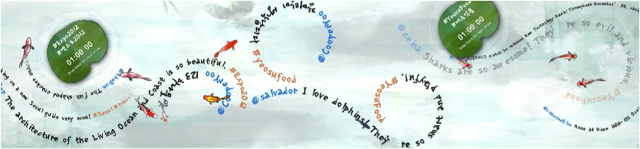
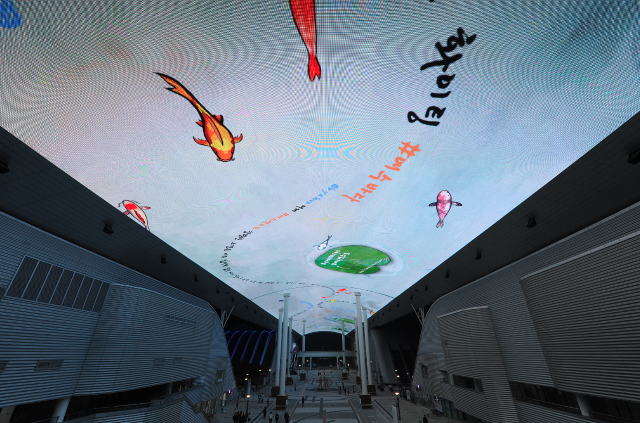
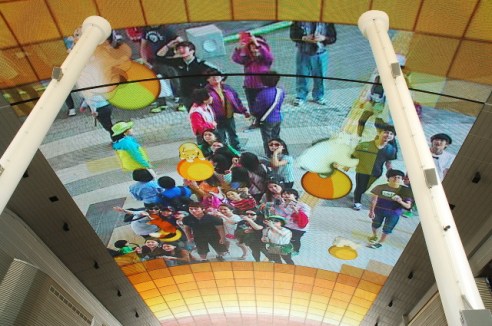
“Oceanus” is a large scale interactive project through Carnegie Mellon University that was designed for Yeosu World Expo 2012 which took place in Yeosu, South Korea and Pittsburgh, Pennsylvania, U.S.  The project used Twitter Application Program Interface which allowed a broad audience to contribute to the project.  When the audience tweeted designated hashtags, their written messages would show up on the screen mounted on the ceiling.

Screen Shot 2012-06-22 at 1.18.49 AM_640

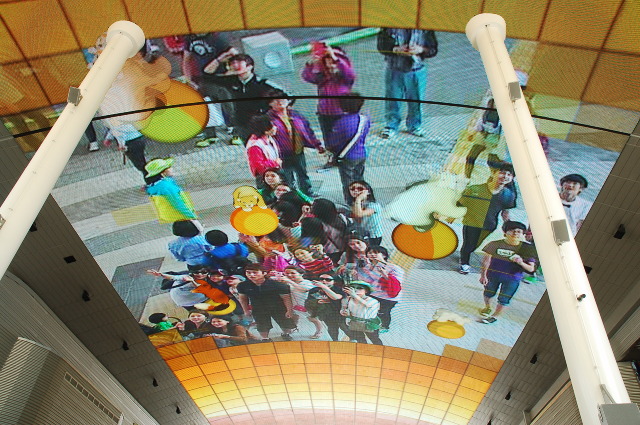
Furthermore, audience members were able to see themselves on the screen through a live video camera.  What fascinated Cooper was how this experience effected people of ages and varying technological abilities.  It broke down the barriers that can sometimes be created by technology, and promoted interaction and conversation among people in the same space.DSC_0500_640

To view more of Cooper Yoo’s work you can check out his website here.

Written by Amy DeCaussin
Director of Projects & Social Media

Visit our website: Laboratory5       Follow us on Twitter: @lab5     Become a fan on Facebook: Laboratory5
Contact Us at anytime – we’d love to hear from you